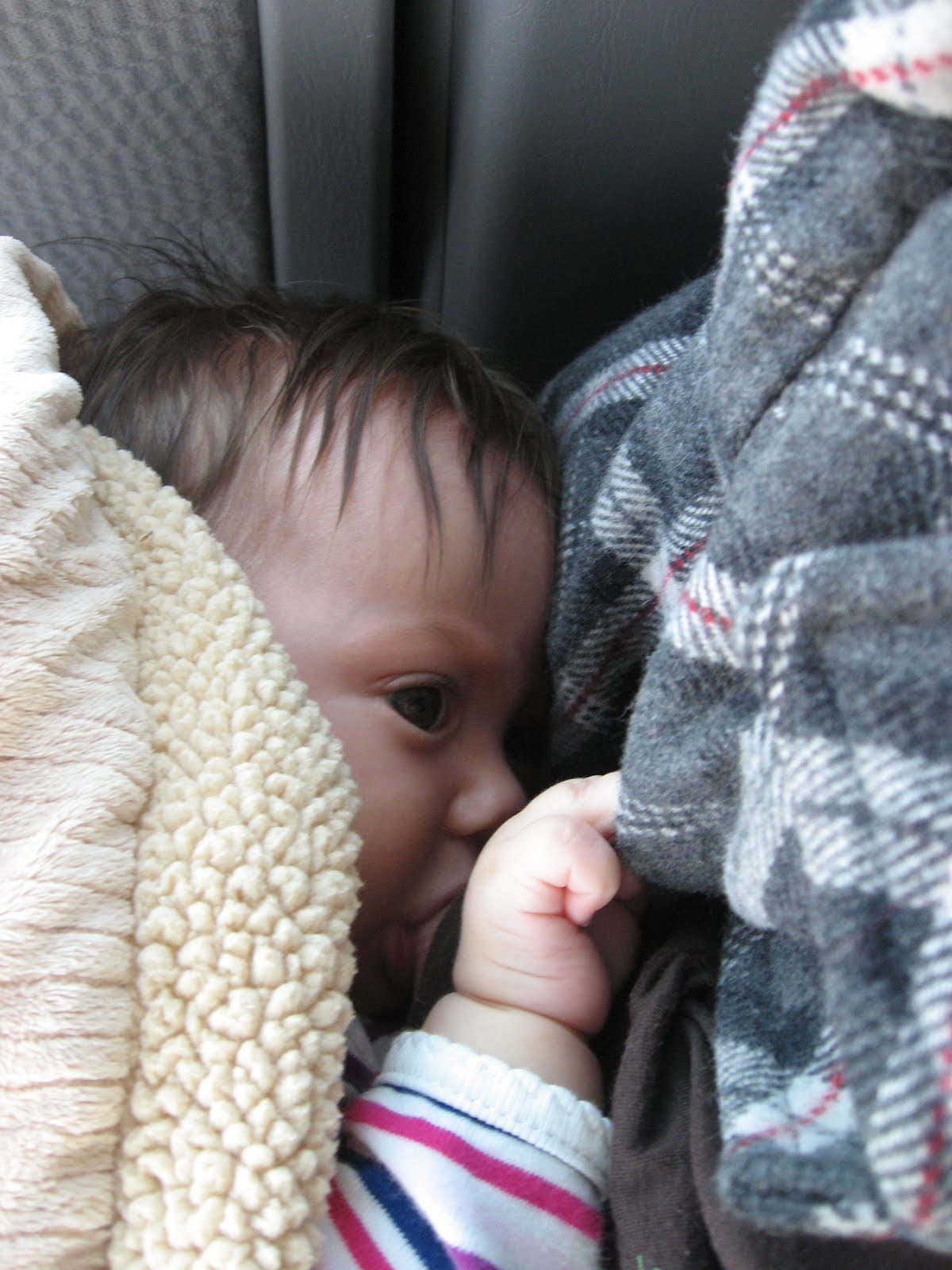
As I nursed my baby before bed tonight I was thinking of how wonderful it is to breastfeed a toddler and how different it is from nursing an infant. Commonly, mothers stop nursing at one year (or sooner) due to a variety of reasons, but I fear mostly it is because breastfeeding a toddler isn't considered normal. There are so many good reasons to continue nursing. Here are my personal top 10.
10. Left the house without a snack? No problem! I self-generate snacks.
9. Toddlers are on the go all the time so sometimes it is really nice to just hold her still in my arms and snuggle.
8. Nursing burns calories like crazy and so I get to eat all the dessert I want!
7. I am healthier. Breastfeeding reduces my risk of breast, ovarian, uterine, and endometrial cancers. It protects against osteoporosis, and reduces the risk of rheumatoid arthritis.
6. I don't have to worry about if my toddler is eating a balanced diet. Picky? Refusing to eat greens? What about calcium? Is she getting enough fat? I've got it covered.
5. I don't have to roam the halls to get her back to sleep when she wakes in the night.
4. It is my all-purpose mothering tool. Cranky? Let's nurse. Hurt? Let's nurse. Scared? Let's nurse. Nursing is the fastest and easiest way to calm her down whether she took a fall or is having a tantrum.
3. She is healthier. Children's immune systems are not fully developed until the age of 3. While other children may be eating chicken nuggets and chocolate milk, mine is getting breast milk. Because of her diet, environment, and the immunity in breast milk, my child has never had anything more than the sniffles, and she only had that a few times. (I should also point out the fact that she does not have to go to daycare. But she does go to the Y and to the church nursery, so she is exposed to other children several times a week.)
2. The nutrition. Breast milk doesn't have an expiration date. There is no time in a child's life that breast milk is not beneficial or even less beneficial. In the second year (12-23 months), 15 oz of breastmilk provides:
29% of energy requirements
43% of protein requirements
36% of calcium requirements
75% of vitamin A requirements
76% of folate requirements
94% of vitamin B12 requirements
60% of vitamin C requirements.
(From Kellymom.com)
1. The bond. Hands-down, nursing is the most precious to me because of the bond it gives me with my daughter. As her nursing needs have become less pure need and more emotional, nursing is a way for her and I both to say I Love You.
click on the picture to enlarge
Saturday, April 21, 2012
Tuesday, April 10, 2012
Tasty Tuesday: Zucchini Ricotta Cheesecake
It's been awhile since I've featured a recipe. Probably because we eat the same old stuff all the time. I'm sure we all get stuck in the recipe rut. We have a few staples, Rice and Beans, and some sort of soup tend to make our weekly menu. Finally, for Easter we decided to make something new. It's from 101 Cookbooks, as usual, but it branched out of my comfort zone considering I thought it would be eggy. Fortunately, this Zucchini Ricotta Cheesecake was not eggy at all! It was delicious and is a great way to eat less bread and gluten in the morning. It is not at all sweet and not at all like a dessert cheesecake. It was cheese cake in the true sense of the word "cheese."
I'm a terrible photographer, but Heidi is quite good, so check out her website for the pretty pictures of this cheese cake.
Zucchini Ricotta Cheesecake
Heidi made hers in a springform pan. I don't have one, so I just used a pie plate and it worked fine.
2 cups zucchini, unpeeled & grated
1 teaspoon fine grain sea salt
2 1/2 cups ricotta cheese
1/2 cup freshly shredded Parmesan cheese
2 shallots, chopped
2 cloves garlic, chopped
1/4 cup fresh dill, chopped
zest of one lemon
2 large eggs, well beaten
1/3 cup goat cheese, crumbled
drizzle of olive oil
Preheat oven to 325F degrees, racks the middle. Butter/oil a 7-inch springform pan or pie plate.
In a strainer, toss the shredded zucchini with the salt and let sit for ten minutes. Now aggressively squeeze and press out as much moisture as you can. Set aside.
In the meantime, combine the ricotta cheese, Parmesan cheese, shallots, garlic, dill and lemon zest in a medium bowl. Stir in the eggs and continue mixing until well combined. Now stir in the shredded zucchini. Fill the springform pan with the ricotta mixture and place on a baking sheet. Place in the oven and bake for sixty minutes. If there is any moisture left on top of the cake at this point, carefully use a bit of paper towel to dab it off. Now sprinkle with the goat cheese and return to the oven for another 20 -30 minutes or until the goat cheese is melted and the cake barely jiggles in the center (it will set up more as it cools).
At this point, if the cake is baked and set, but the top isn't quite golden, zap it with the broiler (just about a minute) to get a bit more color on top. Remove from the oven and let cool five minutes, then release the cake from its pan. Cool completely, serve at room temperature drizzled with a bit of olive oil and a few sprigs of dill.
Thursday, March 15, 2012
Books I Love: The Vaccine Book
OK, so I don't actually love The Vaccine Book, but if it were up to me, each baby would be born with this book.
Did you know you have choices when it comes to what vaccinations you give your baby and even when you give them? I know many, many, too many parents leave all of their children's health care decisions up to the "professional" but YOU know your baby better than anyone and YOU are responsible for your baby's health. The AAP has a recommended vaccination schedule that a group of doctors and the vaccine manufacturers came up with together. The schedule is purely a recommendation and thank God, it is not law. You can actually pick and choose your vaccines, even different brands of the same vaccine, and pick your own schedule. The Vaccine Book by Dr. Robert Sears puts vaccination decisions back in the parent's hands by informing parents of each vaccine.
The book lists each vaccine out on the market today and tells what disease the vaccination targets, how common or rare the disease is, if it is serious, what the vaccine is made of, what the controversial ingredients are, what you should consider by getting it or not getting it, and then a small personal note on the way he sees it. This book is about as unbiased as you are going to get with straight facts (and a sentence or two of Dr. Sears' opinion.) You are not going to get this kind of information at the doctor's office. The doctor is going to tell you what the recommendation is, nothing more, nothing less. They may give you a pamphlet of the vaccines that is made by the manufacturers for parents and only lists what they want you to know. It is going to be completely biased and you are not going to get good information. If you want to really know about vaccines you have to do your own research and this book is a great place to start. In fact, it may be all you need to make your own decisions.
Doctors often do not take too kindly to being told what to do, so you should really shop around for a doctor that fits your philosophy and will treat you, the parent, with respect, and leave the decisions up to you. This is also why they recommend shopping for a ped while you are still pregnant. Not just so you can "get in with the good ones" but so you can find one that fits your parenting philosophies.
Happy reading! Truly making informed decisions about your baby's health is really difficult. You must weigh everything- the facts, your gut instincts, and when you have to make a decision about something so controversial you must pray, pray, pray! After you have weighed all the options you can choose to vaccinate with all the recommended ones, on the recommended schedule, you can choose to vaccinate some on the recommended schedule, you can choose all on a delayed schedule, you can choose some on a delayed schedule, and finally, you can choose none. There are endless combinations and possibilities so don't let anyone else, not your mother, friend, sister, mother-in-law, or even your doctor, decide what you should do. And finally, if you aren't 100% sure, then wait. Don't let anyone jab your baby without your full informed consent. You can always get the vaccine later, but you can never take one back once given.
Further reading, and a preview: The Vaccine Book's Website
Friday, February 17, 2012
Bottle Nursing
Nursing a child is so much more than food or nutrition. It is comfort, bonding, showing love, and even the earliest form of communication. Nursing a child doesn't even have to involve the breast. While breast is best, some are unable to breast feed, or need to bottle feed breast milk. Other situations including day care, foster parenting, or leaving baby with daddy or grandma requires bottle feeding. Bottle feeding is not all bad, or even not bad at all, when done in a nurturing way. Unfortunately, I have seen people bottle feeding their children in ways that are neither loving nor nurturing. Bottle feeding in a car seat always breaks my heart. I've seen a lot of variations -propping a bottle up while the parents have dinner, having an older sibling hold a bottle while the infant is in the car seat perched on a grocery cart, they even make an apparatus that holds the bottle tipped upside down and dangles from the car seat handle. I've known people to prop a bottle up while the infant is in the crib (not only is this sad, but it is very dangerous!). And when the baby is old enough to hold their own bottle I've seen parents just lie them on the floor and give them a bottle, or of course, give it to them in the car seat.
To be fair, breast feeding is not always nurturing either. A nursing mom can find ways to busy herself while feeding too, but it is impossible to breast feed and not touch in some way.
You don't have to breast feed in order to nurse. Bottle feeding done in a loving and respectful way is called Bottle Nursing, or bottle feeding using the breast feeding model. Bottle nursing is:
- Holding the baby close while the caregiver focuses on the child. This enables the baby to gaze at your face, smell your scent, feel security in your arms and in essence, bond.
- Holding the baby close and giving comfort while a baby sucks on a pacifier (mimicking the natural comfort sucking done on the breast.)
- Switching sides while feeding to promote eye-hand coordination (and lets face it, to keep your own arm from going to sleep)
- Feeding on demand.
- Carefully observing when the child is finished, being sure not to over-feed. It is easy to over-feed with a bottle because it often pours out with a little manipulation. Over-feeding at the breast is virtually impossible.
- Allowing your child to seek comfort from you, rather than a bottle, pacifier, or thumb. Not that these "transitional objects" are all bad, but they often replace the needed comfort of a parent. These objects can be useful if a child is in day care, or away from the parent for any period of time, but they shouldn't be relied on when the parent, or primary caregiver is near.
Bottle feeding can absolute be a bonding time if you want it to be. If it is not used as simply a convenience tool, and you focus on your child as you bottle feed, bottle feeding can be just as loving and bonding.
Tuesday, February 7, 2012
Tasty Tuesday: French Onion Soup
French onion soup and Salmon salad. That's what my 18 month old had for lunch yesterday. She actually loves this soup and dips her bread in it like she's been dipping bread in soup all her life! Oh, she has.
There is no such thing as "kid food" in our house. She eats what we eat, and every once in a while I am really surprised by the variety of things she will eat. Like, for example, French Onion Soup. She sops up all the broth with her bread and then eats all the onions out. My husband also said that this is quickly becoming one of his favorite soups, second to Broccoli Cheddar Soup. This recipe is from A New York Times article.
Vegetarian French Onion Soup
The recipe calls for water, and in most recipes, I ignore the water and use veggie broth, but I'd advise actually using water not broth. The miso makes this soup so rich and salty that it can not afford any more salt or flavoring for that matter. Water it is!
1/4 cup plus 1 tablespoon olive oil
2 1/2 pounds large Spanish onions, peeled, halved, and thinly sliced (about 4 cups)
8 diagonal slices of baguette (home-made is nice!), about 1/4 inch thick.
1/3 cup miso
1 tablespoon finely chopped fresh thyme, optional
Salt and freshly ground black pepper
4 large slices Swiss cheese
1. Preheat oven to 325 degrees. Place a large sauté pan over medium-high heat for 1 minute. Add 1/4 cup olive oil, and heat until shimmering. Add the onions and cook, stirring constantly and adjusting heat as needed, until the onions are soft and deep golden brown, about 20 to 25 minutes. Remove pan from heat and allow onions to cool in the pan.
2. Brush both sides of the bread slices with the remaining 1 tablespoon olive oil and place on a baking sheet. Bake, turning once, until just crisp, about 4 minutes a side. Remove from oven and set aside.
3. Pour 3 cups of water into a 2 quart saucepan. Cover and bring to a boil. Add miso, thyme, and cooked onions; mix well. Simmer and season with salt and pepper as needed.
4. Preheat a broiler. Place a large oven-proof serving bowl or four small oven-proof bowls on a broiling pan or small baking sheet. Pour the hot soup into the large bowl or divide among the small bowls. Place the croutons on top of the soup, and top with Swiss cheese slices. Place the pan holding the soup directly under the broiler until the cheese is melted, and the soup is bubbling. Serve immediately.
Friday, February 3, 2012
Changing sleep = better sleep?
I'm pretty sure that if my friends knew how often my 18 month old daughter woke to nurse in the night my mailbox would be stuffed full of BabyWise. But we don't do BabyWise - not in the slightest. We have not, and will not Cry-it-Out. In fact, we have not attempted to sleep-train my baby at all. I truly believe in letting baby take the lead when it comes to nursing and sleep.
I have read about baby sleep on many blogs/forums and in several published books. You see, it isn't all puppy dogs and rainbows at our house - not at night, and not during naps. Naps, *sigh*, oh naps. My baby has been a bad napper since the day she was born. I'm not even going to get into naps. The precious, oh-so-needed oh-so-hard mid day snooze. Naps - she'll have to just outgrow her nap issues. But so many people are having the exact same "problems" with their toddlers. These "problems" are normal and only "problems" if they are disrupting your family dynamic. I have read so many people say "I've made my child HAVE to nurse to sleep. I've created a monster!" It isn't your "fault"! It is extremely natural - a God given instinct. There is a reason every baby in the whole world is able to fall asleep while nursing or even taking a bottle - because mothers' milk is the perfect sedative. It was created that way and is one of your greatest mothering tools. So why WOULDN't you use it!? But sometimes, eventually, you do end up wishing or hoping that your child can go to sleep without the breast.
I would love to let her continue on her own path, nursing happily to sleep at every wake-up until she outgrows the need of my comfort. Left to their own devices, children usually start sleeping through the night somewhere between 2 and 4 years of age. That's right. Let me say that again - children start sleeping through the night between TWO AND FOUR! So next time great-aunt Bessie asks if your newborn is sleeping through the night, just smile and say "She's doing great!" because it actually isn't normal or natural for a baby to sleep through the night. Most every baby who sleeps through the night was trained to do so. Usually by being left alone to cry. Some babies do sleep long stretches on their own, but most wake often. I (mostly) do not mind nursing my baby at night. In fact, I don't even want her to sleep through the night, I'm just asking for a 4 or 5 hour stretch. Nursing at night wouldn't be an issue if she were my last child. But since I'm hoping to have more children, and the frequent nursing is making that a little difficult, we've gotta do something.
We've decided to take the plunge and start semi-night-weaning. It is so complicated. I am my child's lovey. I know I am. Just as you wouldn't snatch away a child's teddy-bear when they awake looking for comfort, so I can't just take away the breast. I want to do it as loving as possible, while still being available for her. I also am not interested in her sleeping 12 straight hours without needing me. As I said, I'm hoping to just go for a four or five hour stretch. We plan to use Dr. Jay Gordon's method. This method is the most baby-friendly method I have found outside of The No-Cry Sleep Solution. The NCSS is great... if it works for you. It doesn't seem to be working for us, because I've been working on some of her advice for the past six months, with no significant changes. Dr. Gordon's method is for night weaning for at least a seven hour stretch. I'm going to cut it down to five and see how it goes.
My baby is starting to show signs of readiness. She can actually fall asleep without the breast at the beginning of the night now. She nurses to sleepiness and pops off on her own and rocks the rest of the way to sleep. Because she can do this now, I think that she should be able to do it during the night. She eats more solids than milk these days, and another important note is that she is not sick or teething (that I'm aware of). I've thought about this and prepared myself and her as much as possible, its just time to do it!
Wednesday, January 18, 2012
Home birth is safe, says new study!
I was very happy to log onto my favorite news source (uh-hem, Facebook) and find this article from USA Today that reads "Study: Home birth with midwife as safe as hospital birth" Glory Hallelujah! I couldn't be more excited to find a major U.S. news source stating what the home birth community already knows.
The study was done in Canada, where midwifery is a more open and more accepted practice than here in the U.S. They documented 13,000 births, about 1/3 were home births with a midwife, 1/3 hospital births with the same group of midwives, and the other 1/3 hospital births with an obstetrician and compared the data sets. They found that out of 1,000 live births, the infant mortality rate among the home birth group was .35, the hospital with a midwife group was .57, and the hospital group who birthed with an OB was .64. The statistics alone say that home birth is actually not as safe as hospital birth - it is SAFER! However, I will concede that they are not necessarily comparing apples to apples. What we need to know is how many of the hospital patients were low-risk births. Midwives will usually not attend home births for clients who have high-risk factors or who have breech babies or premature babies. Many home birthing mothers are overall healthier and pay more attention to diet pre and post conception, which may help have a positive outcome of birth. The article also states that women who birth at home need less medical intervention and have fewer complications like hemorrhage and vaginal tearing.
The article also states the problem with midwifery here in the U.S. is that many states do not regulate midwives. It says that the medical community sees home birth as unsafe because many "midwives" may not have the proper education or necessary credentials. However, there are about a dozen states in the nation where practicing midwifery is illegal, several states who do not license midwives, and several more states where midwives are totally unregulated. This is a complete double-standard where the public is warned that home birth is dangerous because midwifery is not regulated, while the states could choose to regulate and license midwives.
Articles like these bring home birth and midwifery to the public eye, and for that I am very grateful. The more home birth is seen as a safe and good option, the more pressure will be put on states, like my home state, to certify and legalized Certified Professional Midwives.
The picture is my wonderful midwife, checking out my newborn.
Subscribe to:
Posts (Atom)