Showing posts with label nursing. Show all posts

Tuesday, May 22, 2012

Who's "still" nursing?


Well, here it is.  The cover of Time Magazine for May 2012.   I'd say its a pretty great cover considering the point of a magazine cover is to draw attention, and boy, has it.  A thin model-like woman breast feeding a nearly four year old boy.  Of course they chose a pretty young woman and of course they chose a pretty young woman with a child that looks more man than child.  And of course they are in a position that one would never use to breast feed a child so we can all see exactly how big the boy is.  I do appreciate TIME magazine covering extended breast feeding and am glad that it is getting publicity, but they could have done a better job if they really wanted to.  But they didn't really want to, they wanted to shock.  

I absolutely believe that extended breast feeding (breast feeding beyond the age of one year) should be seen as normal and should be talked about but I really think TIME missed the mark on this one.  I believe this is a step back.  This is not going to make anyone see that breast feeding a nearly four year old is normal or natural.  There is not much natural about the picture to begin with.  Here are some pictures that I think better deserve a cover of a magazine and an article on parenting.


this child is also three


The only way we Americans are going to see "awkward" things as normal, natural, and beautiful is to be exposed to them in positive, reassuring ways.  If you talk to a mom who breast fed her children into toddlerhood or beyond and talks positively about it, you are likely going to think good thoughts about that situation.  Myself for example, I always knew I wanted to breast feed my child beyond infancy because I was breast fed until I was two and a half.  My mom always talked about it in a joyful way, telling me that she enjoyed it and I know how healthy I am and how healthy she is partially because of breast feeding, so I knew I wanted to do it too.  We need to encourage one another in our abilities and choices.  Not make it into a competition or laughing stock (thank you, Saturday Night Live).

Which leads me to the subtitle.  Why is it that here in America we have to make everything out to be a competition?  The subtitle says "Are you mom enough?"  I never knew I could be more of a mom than someone else.  Either you are a mom or you are not, there are not degrees of motherhood.  And just because the skinny blonde can breast feed till almost four years old does not mean that everyone can or will.  If you breast feed till four, that is great!  Good for you!  If you breast feed till two, that is great!  Good for you!  If you breast feed for one year, that is great!  Good for you!  And if you bottle feed because you or your child needs it, that is great!  Good for you!  Making someone feel inadequate or making it into a competition where you measure yourself up to what everyone else is doing is a big step backward.

The cover also says "Why Attachment Parenting drives some mothers to extremes.."  Which is a condemnation of extended breast feeding in my opinion.  It is saying that anyone who breast feeds till three or four years old is "extreme".  Maybe it is here, but it really isn't that extreme in other parts of the world.  Why also do we have to follow some method of parenting to "extremes" anyway?  Can we not think for ourselves?  We have to have Dr. Sears or the Ezzos or Ferber telling us what to do with our child every moment of the day?  Why can't we do what is natural to us and what makes sense for our family?  Why do we so often do things just because our friend told us to, or not to, or because Grandma told us to, or not to, or because some author who doesn't know me told me to, or not to?  I think if we take a step back and start looking at parenting truly as family centered (what is best for MY family, regardless of what my neighbor does) then we would have a lot more happy parents and children, and we would have a whole lot more peace about our personal decisions.

Lots of moms all over the world are still nursing, or nursing for the first time, or nursing for the last time. More people than we know are still nursing because they only nurse at home and don't talk about it for fear their friends and strangers will think they are weird.  But it isn't weird, its just weird to our culture.  I was recently called a "third world country mama" teasingly by a friend who found out I am "still" nursing.  Yet there are many other cultures, not just third-world cultures that nurse way longer than Americans do.  Most Europeans wouldn't bat an eye at a two year old nursing.  Maybe we will catch up some day, then we will start having some more positive experiences to share of people who are "still" nursing.

Friday, February 17, 2012

Bottle Nursing

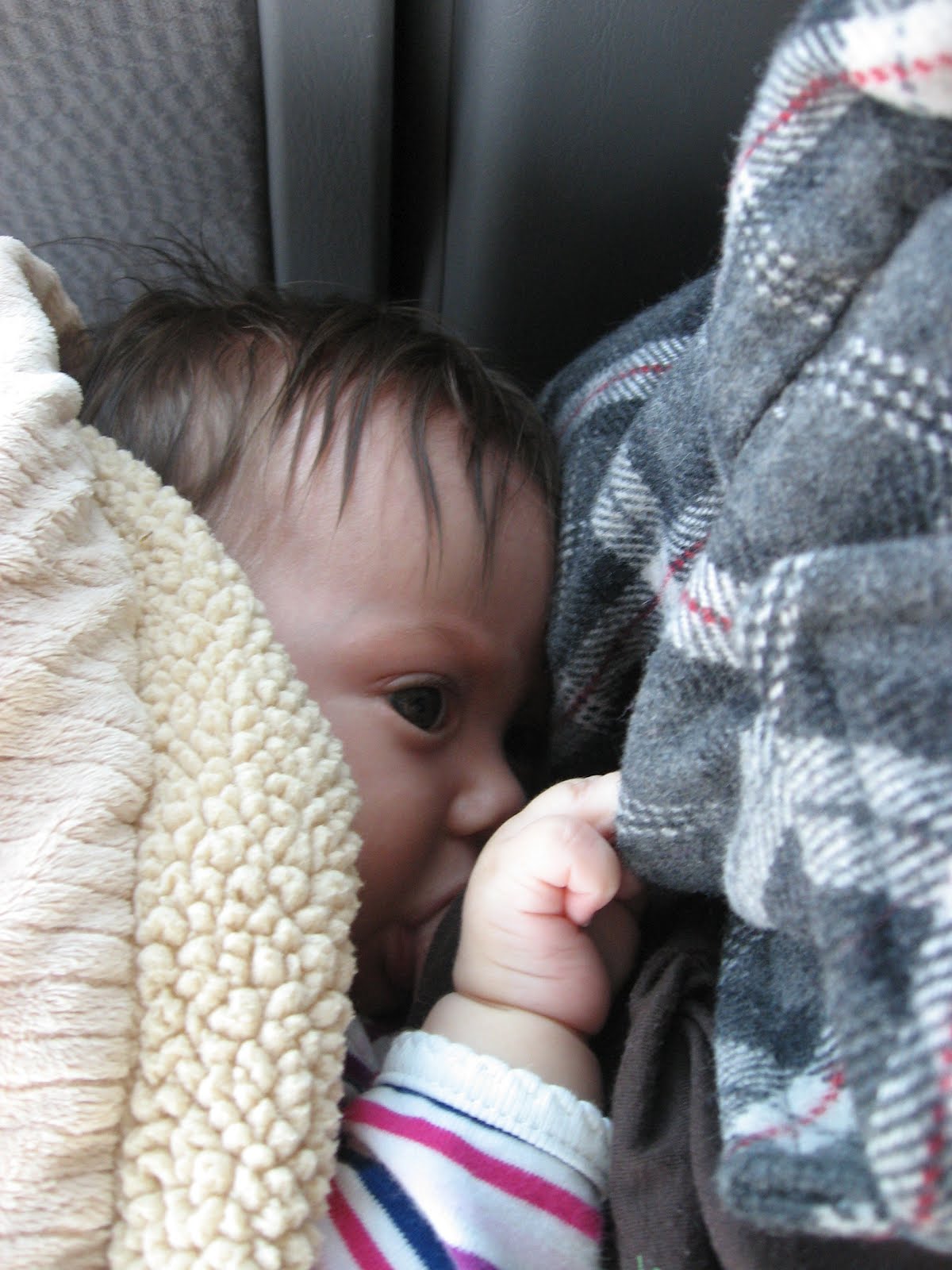
Nursing a child is so much more than food or nutrition. It is comfort, bonding, showing love, and even the earliest form of communication. Nursing a child doesn't even have to involve the breast. While breast is best, some are unable to breast feed, or need to bottle feed breast milk. Other situations including day care, foster parenting, or leaving baby with daddy or grandma requires bottle feeding. Bottle feeding is not all bad, or even not bad at all, when done in a nurturing way. Unfortunately, I have seen people bottle feeding their children in ways that are neither loving nor nurturing. Bottle feeding in a car seat always breaks my heart. I've seen a lot of variations -propping a bottle up while the parents have dinner, having an older sibling hold a bottle while the infant is in the car seat perched on a grocery cart, they even make an apparatus that holds the bottle tipped upside down and dangles from the car seat handle. I've known people to prop a bottle up while the infant is in the crib (not only is this sad, but it is very dangerous!). And when the baby is old enough to hold their own bottle I've seen parents just lie them on the floor and give them a bottle, or of course, give it to them in the car seat.

To be fair, breast feeding is not always nurturing either. A nursing mom can find ways to busy herself while feeding too, but it is impossible to breast feed and not touch in some way.

You don't have to breast feed in order to nurse. Bottle feeding done in a loving and respectful way is called Bottle Nursing, or bottle feeding using the breast feeding model. Bottle nursing is:

- Holding the baby close while the caregiver focuses on the child. This enables the baby to gaze at your face, smell your scent, feel security in your arms and in essence, bond.
- Holding the baby close and giving comfort while a baby sucks on a pacifier (mimicking the natural comfort sucking done on the breast.)
- Switching sides while feeding to promote eye-hand coordination (and lets face it, to keep your own arm from going to sleep)
- Feeding on demand.
- Carefully observing when the child is finished, being sure not to over-feed. It is easy to over-feed with a bottle because it often pours out with a little manipulation. Over-feeding at the breast is virtually impossible.
- Allowing your child to seek comfort from you, rather than a bottle, pacifier, or thumb. Not that these "transitional objects" are all bad, but they often replace the needed comfort of a parent. These objects can be useful if a child is in day care, or away from the parent for any period of time, but they shouldn't be relied on when the parent, or primary caregiver is near.

Bottle feeding can absolute be a bonding time if you want it to be. If it is not used as simply a convenience tool, and you focus on your child as you bottle feed, bottle feeding can be just as loving and bonding.

Friday, February 3, 2012

Changing sleep = better sleep?

I'm pretty sure that if my friends knew how often my 18 month old daughter woke to nurse in the night my mailbox would be stuffed full of BabyWise. But we don't do BabyWise - not in the slightest. We have not, and will not Cry-it-Out. In fact, we have not attempted to sleep-train my baby at all. I truly believe in letting baby take the lead when it comes to nursing and sleep.

I have read about baby sleep on many blogs/forums and in several published books. You see, it isn't all puppy dogs and rainbows at our house - not at night, and not during naps. Naps, *sigh*, oh naps. My baby has been a bad napper since the day she was born. I'm not even going to get into naps. The precious, oh-so-needed oh-so-hard mid day snooze. Naps - she'll have to just outgrow her nap issues. But so many people are having the exact same "problems" with their toddlers. These "problems" are normal and only "problems" if they are disrupting your family dynamic. I have read so many people say "I've made my child HAVE to nurse to sleep. I've created a monster!" It isn't your "fault"! It is extremely natural - a God given instinct. There is a reason every baby in the whole world is able to fall asleep while nursing or even taking a bottle - because mothers' milk is the perfect sedative. It was created that way and is one of your greatest mothering tools. So why WOULDN't you use it!? But sometimes, eventually, you do end up wishing or hoping that your child can go to sleep without the breast.

I would love to let her continue on her own path, nursing happily to sleep at every wake-up until she outgrows the need of my comfort. Left to their own devices, children usually start sleeping through the night somewhere between 2 and 4 years of age. That's right. Let me say that again - children start sleeping through the night between TWO AND FOUR! So next time great-aunt Bessie asks if your newborn is sleeping through the night, just smile and say "She's doing great!" because it actually isn't normal or natural for a baby to sleep through the night. Most every baby who sleeps through the night was trained to do so. Usually by being left alone to cry. Some babies do sleep long stretches on their own, but most wake often. I (mostly) do not mind nursing my baby at night. In fact, I don't even want her to sleep through the night, I'm just asking for a 4 or 5 hour stretch. Nursing at night wouldn't be an issue if she were my last child. But since I'm hoping to have more children, and the frequent nursing is making that a little difficult, we've gotta do something.

We've decided to take the plunge and start semi-night-weaning. It is so complicated. I am my child's lovey. I know I am. Just as you wouldn't snatch away a child's teddy-bear when they awake looking for comfort, so I can't just take away the breast. I want to do it as loving as possible, while still being available for her. I also am not interested in her sleeping 12 straight hours without needing me. As I said, I'm hoping to just go for a four or five hour stretch. We plan to use Dr. Jay Gordon's method. This method is the most baby-friendly method I have found outside of The No-Cry Sleep Solution. The NCSS is great... if it works for you. It doesn't seem to be working for us, because I've been working on some of her advice for the past six months, with no significant changes. Dr. Gordon's method is for night weaning for at least a seven hour stretch. I'm going to cut it down to five and see how it goes.

My baby is starting to show signs of readiness. She can actually fall asleep without the breast at the beginning of the night now. She nurses to sleepiness and pops off on her own and rocks the rest of the way to sleep. Because she can do this now, I think that she should be able to do it during the night. She eats more solids than milk these days, and another important note is that she is not sick or teething (that I'm aware of). I've thought about this and prepared myself and her as much as possible, its just time to do it!

Monday, August 1, 2011

World Breastfeeding Week!

This week is an internationally recognized week for breastfeeding support. World Breastfeeding Week implemented by the World Health Organization is meant to raise awareness of the benefits of breastfeeding and build support for women who want to breastfeed. You may wonder why we need awareness and support? In one of my previous posts, I pointed out that many women do not breastfeed beyond infancy. There are also countless stories of women being harassed or embarrassed for nursing in public. Just a few weeks ago I read a story of a woman on a bus in Detroit who was told by the bus driver to quit breastfeeding or get off the bus. The woman was nursing a two week old baby! Fortunately, Michigan has a law that protects a woman's right to breastfeed in public (as do most states) but the woman was harassed nonetheless!

Just anecdotally, I notice many women (from forums online and my personal friends) who have trouble or choose not to nurse beyond a few months. Is this because they do not have enough support? Is this because of priorities? Is it cultural influence? As it is, women are choosing formula over breast milk in many cases. The link above states "Exclusive breastfeeding has been recognized as the single most effective intervention to reduce under-five mortality; optimal feeding practices - including early initiation, exclusive breastfeeding and continued breastfeeding while providing safe and appropriate complementary foods - could reduce mortality among children by one fifth. Breastfeeding also helps mother and child to establish a close and loving relationship."

I'm a self proclaimed lactivitst. I love, love, love (love, love) nursing. My husband points out often that not everyone loves nursing as much as I do. That may be true, and I also recognize that nursing a toddler is not for everyone. But I am going to support and promote breastfeeding and allowing self-weaning as much as I can! There are so many more mothers who nurse toddlers and preschoolers than we will ever know because they are too embarrassed to nurse in public. That, and the simple fact that toddlers do not need to nurse as often as infants, so you rarely see toddlers and preschoolers nursing out of the house. But I say - Get out there! The only way to make breastfeeding and especially breastfeeding older babies and toddlers normal is exposure. Thankfully, I have never been harassed for breastfeeding, but if I am, you bet that stranger is going to know more about breastfeeding when I'm done with them than they ever wanted to know!

Wednesday, June 29, 2011

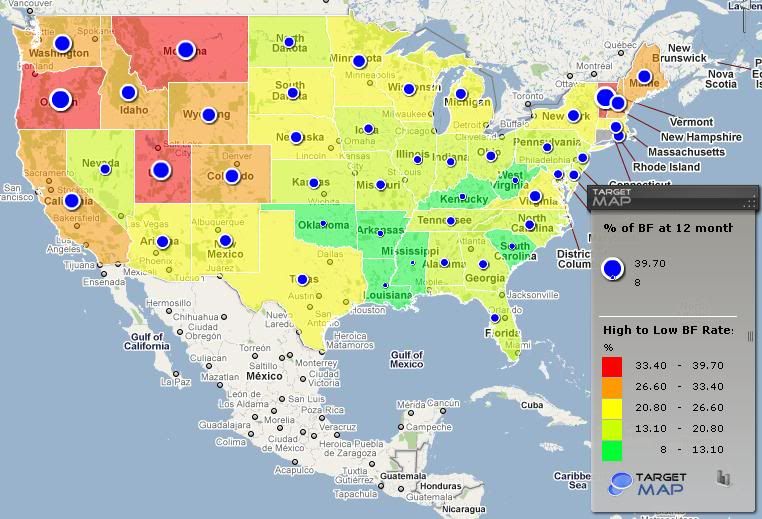
Breastfeeding Beyond Infancy in the United States

map from www.targetmap.com click on the first map on the page and it will bring up a large interactive map.

I'm proud to say I am in the 15.9% of moms in Alabama who breastfeed beyond 12 months. Or rather - I WILL be, since my baby is yet 11 months. This article by Cafe Mom is based on the CBS article that gathered the CDC data on breastfeeding beyond 12 months of age. Sadly, it shows that less than half of all moms breastfeed beyond 12 months. Yet the American Academy of Pediatrics (AAP) says to breastfeed for AT LEAST one year, and the World Health Organization (WHO) says to breastfeed for AT LEAST two years! The world average for weaning is actually four years. America relies too heavily upon formula and cow's milk.

The south has major problems when it comes to extended breastfeeding. Almost all of the 10 states with the lowest rates of extended breastfeeding are below the mason-dixon line. Is it because we seriously lack breastfeeding education? Is it because the south holds the nation's poverty states? Yes, and yes. It is especially hard to receive support to breastfeed while working full time. I have seen even casually on Facebook women who do not understand or see the value of nursing beyond 12 months of age. This article at Kellymom.com lists facts with scientific references of why breastfeeding beyond 12 months is still best for mom and baby.

Highlights of why breast is still best beyond 12 months (from kellymom.com):

- "Breastfeeding continues to be a valuable source of nutrition and disease protection for as long as breastfeeding continues." The benefits of breast milk do not suddenly expire at 12 months. It also supplies complete nutrition to toddlers and babies alike. Many toddlers do not eat well; with breastfeeding, a mom need not worry.

- Breastfed children are sick less often. The WHO quotes "a modest increase in breastfeeding rates could prevent up to 10% of all deaths of children under five: Breastfeeding plays an essential and sometimes underestimated role in the treatment and prevention of childhood illness."

-Breastfed children have fewer allergies

-Breastfed children are smart. There is evidence that breastfed children have higher IQ's. (There are a ton of references on Kellymom.com - check it out)

-Breastfed children are well adjusted. I know breastfeeding is my all purpose mothering tool that I'm not about to give up. It solves almost any problem, and research indicates that meeting a child's needs in this way creates a MORE independent child later in life.

-Breastfeeding past infancy is normal. As already stated, the average weaning age the world over is age 4. In fact, there are a lot more extended nursing moms than we know because they are often too embarrassed to nurse in public for fear they will be criticized or seen as weird. Also, you don't see toddlers breastfeeding in public as much as infants because they simply do not need to nurse as often. I think the only way to make extended breastfeeding normal is to go ahead and breastfeed out of the proverbial closet!

-Breastfeeding benefits the mother past infancy. All the great things breastfeeding can do for you still apply. Breastfeeding reduces the risk of ovarian, breast, uterine, and endometrial cancer. It also helps prevent osteoporosis and arthritis. And of course, breastfeeding moms lose weight easier.

I hope this encourages those who are considering extended breastfeeding and encourages others to support women who are breastfeeding! I can proudly say I was breastfed until I was 2.5 years old. This was in the late 70's early 80's when hardly anyone breastfed. Thanks, Mom!

Wednesday, March 23, 2011

Tainted Breast milk - a quiz!

When comparing to nursing mothers who do not eat meat, how much more pesticide contamination do nursing mothers who eat meat have in their breast milk?

a. Twice as much

b. Thirty-five times as much

c. Ten Times as much


Answer: b. Thirty five times as much!*

To reduce pesticide contamination choose lean cuts of organic meat and low-fat organic dairy products. Or go meat free! Pesticides are stored in fatty cells, so lean and low fat will contain less.

*D. Colbert, M.D.. The Seven Pillars of Health. Siloam, 2007.

Thursday, March 17, 2011

My milk supply is a garden.

"Milk supply is not something you can just spontaneously lose, like a set of keys or a pair of glasses. It's more like a garden. Neglect it, by limiting feedings or supplementing with formula, and it will wither. Tend it, by feeding on demand, and it will flourish."

That was a great quote I found on a message board. I have no idea who the poster is, but I wanted to share it.

If you have or plan on breastfeeding it seems all the rage is "will I have enough milk?" or "is my supply dropping?" I just finished reading (probably three times) The Womanly Art of Breastfeeding. It is a beautiful, timeless book by La Leche League International. I know a lot of people think the LLL is a little weird, but maybe that is because they have not read the book. It is a beautiful description and comprehensive problem solver on all things breastfeeding. If anyone knows how to nurse, its the LLL. They stress on demand feeding for a healthy milk supply. The hormones that make milk are absolutely amazing. They respond perfectly to YOUR baby. It is supply and demand at its finest. Restrict the demand by watching the clock or substituting yourself with a pacifier and you might have supply problems. The first several months of a newborn's life are crucial to the mother's milk supply for the entire nursing relationship. The first weeks and months "set" the milk supply. Restrict feedings for whatever reason and the mother may not be able to keep up with her baby's need in the months to come. Of course there can be other reasons for a low milk supply than not nursing on demand, there is a good list here. The book covers this and has suggestions for increasing supply. One thing I found very interesting is that, according to the book, more women have an oversupply than undersupply. This is also covered, with suggestions.

The book covers so many subjects, with sections on nursing according to age, starting solids, sleep, weaning, and a pretty good problem solving chapter. But its main point centers around On Demand feeding. It seems that is the only way to keep a baby happily nursing for one, two, or more years. I loved this extremely well written book. It made me happy, it made me cry, and it made my love for my baby bubble up and spill over every time I read it. If you have nursed, are nursing, or think you might nurse, this is the only book you need.

The Womanly Art of Breastfeeding by Diane Wiessinger, La Leche League International, Diana West, Teresa Pitman

Wednesday, March 2, 2011

Tasty Wednesday - Creamy Greens Smoothie


Its been awhile since I've featured a recipe, so I thought we could use one, even on a Wednesday! I've added this shake for snacks lately because I have been trying to consume more calories since nursing burns calories like crazy.

This recipe is from the book "The Vegetarian Mother's Cookbook" by Cathe Olson. She says "This smoothie surprises everyone because it tastes so good." It truly does. You can not taste the kale, I promise. Coconut milk and pineapple juice is very refreshing! It is good for nursing and pregnant mothers for the Vitamin K and chlorophyll, the nutritional yeast adds protein. This also might be something a pregnant woman can choke down during times of morning sickness, though cold foods can make nausea worse, something to think about.

Creamy Greens Smoothie

1/2 cup pineapple juice
1/2 cup light coconut milk
1 banana, sliced and frozen (I usually only use half)
2 to 3 kale leaves (the kale in the picture is purple)
2 teaspoons nutritional yeast flake (optional)

Place ingredients in a blender and puree until smooth.

Calories: 292, Protein: 6g, Carb: 51g, Fat 9g, Fiber 5g
High in Vitamin A, Folate, B6 and B12.

I usually do not advise drinking fruit juice because it is so high in sugar and it is much better to eat the fruit than drink the juice. Pretty much all 51g of carbs are from sugar in this smoothie. That is cut down if you only use 1/2 a banana. However, its a good way to get greens, so I'll let this one slide. Just don't sneak glasses of pineapple juice otherwise!

Wednesday, January 12, 2011

Mom's Diner - Open All Night!!

I can't have a pregnancy/baby blog without talking about breastfeeding. I've kinda delayed this post since I thought some people might be sensitive to the subject. But I can not resist any longer. I love nursing my baby, and it is truly the most special time for both me and Mary Abilene.

Breastfeeding is the perfect design for mother and baby, and specifically formulated for YOUR baby.  Did you know that if you have a preemie the nutrition in your breastmilk is different than for a full term baby?  The milk content changes as your baby ages.  There is nothing more perfect in the world than your milk for your baby.  It is essentially manna from Heaven. Food provided essentially out of nowhere. Aside from the nutrition, it is the most precious bond I can image between mother and child.  Anyone can feed your baby a bottle, only you can breastfeed your baby. 

I saw an article that said in the late 1950's and early '60's, only 9% of women left the hospital breastfeeding.  That is shocking and sad.  Formula companies were booming and they were making every effort to get women to use their formula rather than breastfeed.  They even thought cow's milk was superior to human milk.  Let's think.  Cow's milk is for baby cows.  Kangaroo's milk is for baby kangaroos.  And human milk is for baby humans.  Even the AAP, nowadays, says that a mother should breastfeed exclusively for six months (that means no solids for six months either.)  And then continue for AT LEAST a year.  (Surprising the AAP recommends this, since no one makes any money off breastfeeding. But enough of the cynicism, I digress.)  It is hard, in this American culture, to find women that breastfeed beyond a year, but almost every other culture breastfeeds well past that year.  Some even continue to nurse until the next baby is born.  Just food for thought.

The formula companies spend lots and lots of money convincing you that you do not need to breastfeed and that formula is a good replacement. Congress wanted to start a Breastfeeding campaign and the formula companies put a hasty stop to that. All they care about is your money. NOT your baby.

Ok, so my  point of this post is to share some hard facts on breastfeeding versus formula feeding.  I got this fact sheet when I took a breastfeeding class before Mary Abilene was born.  The following are highlights from the sheet, because the whole thing won't fit on my blog...

Aside from the cost of formula itself, which is typically $1500-$2000 per year, not breastfeeding is costing a lot in health care. In an article by Hoey and Ware (1997) they stated the total annual cost of not breastfeeding was $1.186 to $1.301 BILLION in health care expenses.

Breastfeeding contains 100,000 living cells in every teaspoon, while formula is dead and has none. Formula also only contains some of the nutritional ingredients and none of the antibodies or immunity.

I didn't know until just recently that almost all formula contains high fructose corn syrup! Sometimes it is even the first ingredient!!

So, the long and short of it is that Breast really is Best. I understand people do have problems breastfeeding. It is important to find a lactation consultant as soon as possible! And stick with it if at all possible. Even if you have to supplement. It is so worth it. I wouldn't give up breastfeeding for anything in the world.