This recipe in The Vegetarian Mother's Cookbook by Cathe Olson is another way I've ruined eating out. When we can make our favorite foods at home, what reason is there to eat out?! The only difference between this delicious falafel and traditional restaurant falafel is that this isn't deep fried. It isn't near as crunchy, but saves you calories and fat in oil.
The tangy tahini sauce is fast becoming a go-to sauce for us. We love it for veggie wraps and I bet it would be great as a crudite dip.
Falafel with Tangy Tahini Sauce
4 cups cooked chickpeas, drained (canned is fine)
3 cloves garlic, minced
2 tsp ground cumin
1 tsp ground turmeric
1 tsp ground coriander
1 tsp sea salt
1/3 cup minced onion
1/4 cup minced parsley
1/3 cup water
1 tbsp lemon juice
1/4 tsp black pepper
1/3 cup flour (any kind - I used WW pastry, cause thats what I had)
Tangy Tahini Sauce:
1/4 cup plain yogurt
1/4 cup tahini
1 tbsp lemon juice
1/4 tsp sea salt
1/4 to 1/3 cup water
Simply puree all ingredients for falafel in a food processor until smooth. Add a little more water if necessary to get a smooth consistency. If possible, let batter sit 1 hour before cooking to thicken and intensify flavor (CB note: I did let mine sit and I think the onion became less pungent and everything married nicely.)
Use your hands to form patties approximately 3 in diameter and 1/2 in thick. Cook patties using one of the two methods below:
1) Oven method: Preheat oven to 450F. Place patties on oiled baking sheet and bake for 10 minutes on each side or until brown and crisp. This method works well to cook all the patties at once.
2) Pan Method: Warm a skillet to medium heat. Pour in just enough oil (I used coconut oil) to coat the pan. Drop in patties (4 or so at a time) and grill 10 minutes on each side, or until brown and crisp. Add additional oil if needed and add oil between batches.
To make sauce:
Puree yogurt, tahini, lemon juice, and sea salt in a blender or food processor. While blending add water a little at a time until desired thickness is achieved.
Serve falafel with sauce or in a pita pocket with tomato, lettuce, and cucumber.
I have used the pan cooking method with great results. I haven't tried the oven method yet. This would also be a great freezer recipe. Use the oven method for that and freeze the patties, individually wrapped. Thaw and then reheat in oven.
Tuesday, July 12, 2011
Friday, July 8, 2011
Sanitizing Sanity
In this article by the Center for Disease Control (CDC), I found that in the mid 1990's only a few antibacterial products were used in the home. They were designed and produced for hospital use where there are a concentrated amount of bacteria, and deadly ones at that. Antibacterial products were specifically designed to protect vulnerable patients - not the average healthy individual. Ten years ago when the article was written, there were more than 700 antibacterial products manufactured for the average healthy home. There are assuredly even more than that today. The market is absolutely flooded with antibacterial claims, and advertising is doing a great job selling these products to consumers. There are even entire mattresses manufactured with antibacterial agents. They are starting to show up in food storage containers and we all think that the more antibacterial products you can buy, the healthier your family will be.
The big deal
You may be thinking "Well, isn't it a good thing - we are killing bacteria before it becomes a problem." You may think of it as preventative. The problem is a well-known scientific concern that is true with antibiotics as well as antibacterial cleaners. Antibiotics have been prolifically overused and misused creating antibiotic-resistant strains. This causes "super germs" that are not responsive to antibiotics. This is why it is critical to not take antibiotics unless it is absolutely necessary. The same problem is happening in our households. When antibacterial agents are overused and used without warrant in a normal environment, antibacterial resistant strains are developed. Meaning the more you try to kill germs, the more and stronger germs you will have.
Let me put this another way. Chemically speaking, bacteria is measured in parts per million (ppm). That is 1,000,000. If you are using a product, say LysolTM, that claims it kills 99.9% of germs then you have .1% germ left over. The problem is not that it is just .1% germ, it is 1,000 germs left over. These 1,000 germs are leftover because the antibacterial agent could not kill them. Now these germs are left to breed with each other making more and more antibacterial resistant germs. Soon you have a house full of super germs that all the chemical antibacterial products in the world can not kill.
Further more, the antibacterial agent usually found in soap, tricolsan is under investigation with the FDA due to health concerns. In a Swedish study, tricolsan is now showing up in breast milk! Other chemicals found in antibacterial products like hexane and 1,3-Butadiene are known carcinogens.
Your immune system
Another reason to avoid antibacterial products is to allow your immune system to do its job. I really believe the more antibacterial products you use, the MORE sickness and disease you will experience. Your immune system, like the rest of your body, needs exercise to function properly. A healthy person can be exposed to a variety of weak germs and not become ill. Someone in your house can become sick, and you not get it - that's your immune system at work. The immune system needs regular contact with some germs and bacteria in order to work up a resistance to these germs. If the immune system does not have this opportunity, it is more likely to become sick from even the weak germs that you contact. Hand sanitizer is only effective against 99.9% of germs. That .1% that now survives is more likely to make a person sick if their immune system has not been exposed to other agents.
In the same CDC article mentioned above, allergies also play a role. The stronger the immune system, the fewer allergies a person will have. Over-cleansing an environment can actually lead to more frequent and severe allergies.
Hand Sanitizing Frenzy
I stand firmly against the use of hand sanitizer for all the reasons listed above. Hand washing has seemingly become a thing of the past. I have seen parents slather hand sanitizer on their children before a meal, and I have seen women forgo washing their hands in the bathroom only to pump out a few handfuls of hand sanitizer! Why there is hand sanitizer next to soap and water I will never know! Not only is hand sanitizer a major problem for the reasons listed above, but most hand sanitizer sanitizes with alcohol. The American Association of Poison Control Centers confirmed that hand sanitizer can in fact seriously harm a child who ingests enough of it. There was a story a few years back about a four year old who was rushed to the ER after licking hand sanitizer off her hands that was squirted into her palm by her teacher. This story spread like wildfire and was confirmed by the Poison Control Center.
The safe alternatives
Wash your hands! Hand washing washes away germs and is more effective than trying to kill them. Can you imagine if your doctor before a major surgery decided not to take the time to wash his hands, but instead squirted a large amount of hand sanitizer into his hands!?
Vinegar has been shown to kill 99% of bacteria, 82% of mold, 80% of viruses, and as a bonus - its cheap! Vinegar has not been shown to create resistant strains, either. Vinegar is not labeled as an antibacterial agent because it is not registered with the EPA as a pesticide. Which means that any product labeled as antibacterial is registered as a Pesticide. Hydrogen peroxide is also a great safe antibacterial agent. It can be used to effectively clean counters that have come in contact with raw meats.
Furthermore, decide if your house really needs any antibacterial cleaners. Personally, the only reason I see to use any antibacterial products in the home, including antibacterial hand soap, is if you have a family member with an immune deficiency.The majority of healthy households will find them unnecessary.
Levy, Stuart B., 2001: Antibacterial Household Products: Cause for Concern. Emerging Infectious Diseases, 7, No.3.
Wednesday, June 29, 2011
Breastfeeding Beyond Infancy in the United States
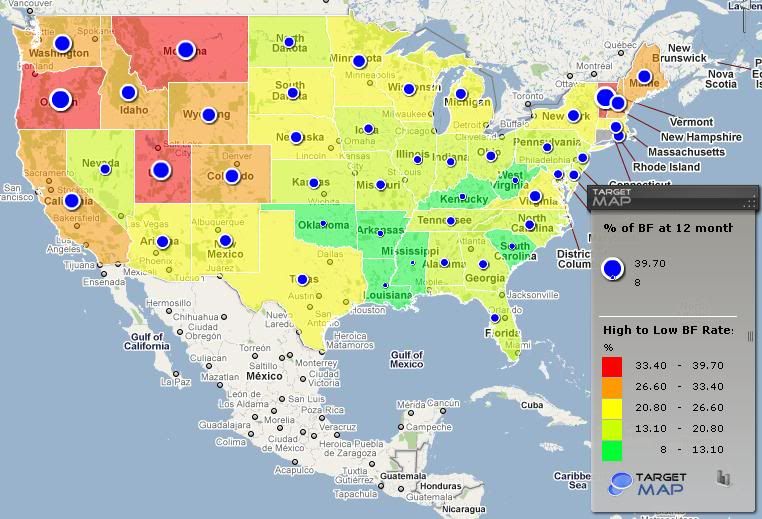
map from www.targetmap.com click on the first map on the page and it will bring up a large interactive map.
I'm proud to say I am in the 15.9% of moms in Alabama who breastfeed beyond 12 months. Or rather - I WILL be, since my baby is yet 11 months. This article by Cafe Mom is based on the CBS article that gathered the CDC data on breastfeeding beyond 12 months of age. Sadly, it shows that less than half of all moms breastfeed beyond 12 months. Yet the American Academy of Pediatrics (AAP) says to breastfeed for AT LEAST one year, and the World Health Organization (WHO) says to breastfeed for AT LEAST two years! The world average for weaning is actually four years. America relies too heavily upon formula and cow's milk.
The south has major problems when it comes to extended breastfeeding. Almost all of the 10 states with the lowest rates of extended breastfeeding are below the mason-dixon line. Is it because we seriously lack breastfeeding education? Is it because the south holds the nation's poverty states? Yes, and yes. It is especially hard to receive support to breastfeed while working full time. I have seen even casually on Facebook women who do not understand or see the value of nursing beyond 12 months of age. This article at Kellymom.com lists facts with scientific references of why breastfeeding beyond 12 months is still best for mom and baby.
Highlights of why breast is still best beyond 12 months (from kellymom.com):
- "Breastfeeding continues to be a valuable source of nutrition and disease protection for as long as breastfeeding continues." The benefits of breast milk do not suddenly expire at 12 months. It also supplies complete nutrition to toddlers and babies alike. Many toddlers do not eat well; with breastfeeding, a mom need not worry.
- Breastfed children are sick less often. The WHO quotes "a modest increase in breastfeeding rates could prevent up to 10% of all deaths of children under five: Breastfeeding plays an essential and sometimes underestimated role in the treatment and prevention of childhood illness."
-Breastfed children have fewer allergies
-Breastfed children are smart. There is evidence that breastfed children have higher IQ's. (There are a ton of references on Kellymom.com - check it out)
-Breastfed children are well adjusted. I know breastfeeding is my all purpose mothering tool that I'm not about to give up. It solves almost any problem, and research indicates that meeting a child's needs in this way creates a MORE independent child later in life.
-Breastfeeding past infancy is normal. As already stated, the average weaning age the world over is age 4. In fact, there are a lot more extended nursing moms than we know because they are often too embarrassed to nurse in public for fear they will be criticized or seen as weird. Also, you don't see toddlers breastfeeding in public as much as infants because they simply do not need to nurse as often. I think the only way to make extended breastfeeding normal is to go ahead and breastfeed out of the proverbial closet!
-Breastfeeding benefits the mother past infancy. All the great things breastfeeding can do for you still apply. Breastfeeding reduces the risk of ovarian, breast, uterine, and endometrial cancer. It also helps prevent osteoporosis and arthritis. And of course, breastfeeding moms lose weight easier.
I hope this encourages those who are considering extended breastfeeding and encourages others to support women who are breastfeeding! I can proudly say I was breastfed until I was 2.5 years old. This was in the late 70's early 80's when hardly anyone breastfed. Thanks, Mom!
I'm proud to say I am in the 15.9% of moms in Alabama who breastfeed beyond 12 months. Or rather - I WILL be, since my baby is yet 11 months. This article by Cafe Mom is based on the CBS article that gathered the CDC data on breastfeeding beyond 12 months of age. Sadly, it shows that less than half of all moms breastfeed beyond 12 months. Yet the American Academy of Pediatrics (AAP) says to breastfeed for AT LEAST one year, and the World Health Organization (WHO) says to breastfeed for AT LEAST two years! The world average for weaning is actually four years. America relies too heavily upon formula and cow's milk.
The south has major problems when it comes to extended breastfeeding. Almost all of the 10 states with the lowest rates of extended breastfeeding are below the mason-dixon line. Is it because we seriously lack breastfeeding education? Is it because the south holds the nation's poverty states? Yes, and yes. It is especially hard to receive support to breastfeed while working full time. I have seen even casually on Facebook women who do not understand or see the value of nursing beyond 12 months of age. This article at Kellymom.com lists facts with scientific references of why breastfeeding beyond 12 months is still best for mom and baby.
Highlights of why breast is still best beyond 12 months (from kellymom.com):
- "Breastfeeding continues to be a valuable source of nutrition and disease protection for as long as breastfeeding continues." The benefits of breast milk do not suddenly expire at 12 months. It also supplies complete nutrition to toddlers and babies alike. Many toddlers do not eat well; with breastfeeding, a mom need not worry.
- Breastfed children are sick less often. The WHO quotes "a modest increase in breastfeeding rates could prevent up to 10% of all deaths of children under five: Breastfeeding plays an essential and sometimes underestimated role in the treatment and prevention of childhood illness."
-Breastfed children have fewer allergies
-Breastfed children are smart. There is evidence that breastfed children have higher IQ's. (There are a ton of references on Kellymom.com - check it out)
-Breastfed children are well adjusted. I know breastfeeding is my all purpose mothering tool that I'm not about to give up. It solves almost any problem, and research indicates that meeting a child's needs in this way creates a MORE independent child later in life.
-Breastfeeding past infancy is normal. As already stated, the average weaning age the world over is age 4. In fact, there are a lot more extended nursing moms than we know because they are often too embarrassed to nurse in public for fear they will be criticized or seen as weird. Also, you don't see toddlers breastfeeding in public as much as infants because they simply do not need to nurse as often. I think the only way to make extended breastfeeding normal is to go ahead and breastfeed out of the proverbial closet!
-Breastfeeding benefits the mother past infancy. All the great things breastfeeding can do for you still apply. Breastfeeding reduces the risk of ovarian, breast, uterine, and endometrial cancer. It also helps prevent osteoporosis and arthritis. And of course, breastfeeding moms lose weight easier.
I hope this encourages those who are considering extended breastfeeding and encourages others to support women who are breastfeeding! I can proudly say I was breastfed until I was 2.5 years old. This was in the late 70's early 80's when hardly anyone breastfed. Thanks, Mom!
Tuesday, June 28, 2011
Tasty Tuesday- Homemade Veggie Stock
I buy veggie broth for a variety of things besides just soup. Though we do go through a ton of veggie broth in the winters for soup, I use broth year round to cook rice and quinoa so the grains will actually taste like something. I buy organic veggie broth which I can get for less than $3 on sale. Lately it occurred to me that I could make my own broth!
I found a great tip online - whatever vegetable "leavins" you have, i.e. the ends of onions, peppers, squash, the stalks of kale, stems of spinach, potato peels, etc, etc, put them in a freezer bowl or bag. Be sure to thoroughly wash the whole vegetable before you chop it so your "leavins" will be clean! Whenever the bowl or bag fills put the frozen vegetable pieces in a big pot and make veggie stock! This method certainly puts your unused vegetable portions to good use and then costs you absolutely nothing extra! Talk about green!
Homemade Vegetable Stock
Fill a large stock pot with a variety of vegetable at least 1/2 full.
Vegetables should include onions, and anything else you desire.
Add three cloves of garlic, whole, skins and all, but smashed with a knife.
A couple bay leaves, a handful of fresh parsley, and 10-15 whole peppercorns if you have it.
Add three tsp salt (or to taste). Adjust depending on the amount of water you add.
Fill the pot with water so it completely covers the vegetables.
Bring to a boil and then reduce to a simmer. Simmer for at least one hour - you don't have to watch the clock too closely. Strain into jars. Broth will keep in the refrigerator for about a week and in the freezer for about two months.
I found a great tip online - whatever vegetable "leavins" you have, i.e. the ends of onions, peppers, squash, the stalks of kale, stems of spinach, potato peels, etc, etc, put them in a freezer bowl or bag. Be sure to thoroughly wash the whole vegetable before you chop it so your "leavins" will be clean! Whenever the bowl or bag fills put the frozen vegetable pieces in a big pot and make veggie stock! This method certainly puts your unused vegetable portions to good use and then costs you absolutely nothing extra! Talk about green!
Homemade Vegetable Stock
Fill a large stock pot with a variety of vegetable at least 1/2 full.
Vegetables should include onions, and anything else you desire.
Add three cloves of garlic, whole, skins and all, but smashed with a knife.
A couple bay leaves, a handful of fresh parsley, and 10-15 whole peppercorns if you have it.
Add three tsp salt (or to taste). Adjust depending on the amount of water you add.
Fill the pot with water so it completely covers the vegetables.
Bring to a boil and then reduce to a simmer. Simmer for at least one hour - you don't have to watch the clock too closely. Strain into jars. Broth will keep in the refrigerator for about a week and in the freezer for about two months.
Wednesday, June 8, 2011
Soaking grains and nuts - an update
I posted a couple weeks ago about Soaking Grains and I promised a follow-up. Basically I have soaked oatmeal, rice, and almonds. I soaked oats in yogurt starting the night before. In the morning we (actually my husband) cooked the oats as usual on the stove top with the soaking liquid. Well, I didn't like the flavor so much. You can very much taste the fermentation. HOWEVER, draining the soaked oats and rinsing a bit gets rid of the fermentation taste. Not bad. I made granola from soaked, drained and rinsed oats and I didn't taste fermentation at all, however - I think I did it wrong. I'll post about that when I get it right.
Soaking and then dehydrating almonds, however, is DELICIOUS! I soaked almonds with water and yogurt for 8 hours. I, drained, rinsed, and spread them on a baking sheet. I put them in the oven for 8 hours at 175F. They came out beautifully crunchy and with that yummy roasted taste. I made almond butter with these almonds and it was the best almond butter I've made thus far. I'm definitely going to soak and dehydrate all my almonds from now on.
My friend made bread from soaked wheat last week - maybe she will share the recipe so I can test that out next!
Soaking and then dehydrating almonds, however, is DELICIOUS! I soaked almonds with water and yogurt for 8 hours. I, drained, rinsed, and spread them on a baking sheet. I put them in the oven for 8 hours at 175F. They came out beautifully crunchy and with that yummy roasted taste. I made almond butter with these almonds and it was the best almond butter I've made thus far. I'm definitely going to soak and dehydrate all my almonds from now on.
My friend made bread from soaked wheat last week - maybe she will share the recipe so I can test that out next!
Tuesday, June 7, 2011
Tasty Tuesday- Honey Whole Wheat BAGELS!
Homemade bagels!? Yes, please!!
This recipe is from Heavenly Homemakers which is a great recipe blog.
Honey Whole Wheat Bagels
4 to 4 1/2 cups whole wheat flour
1 pkg yeast (2 1/4 teaspoons)
1 1/2 cups warm water (110F ish, or just warmer than your hands)
3 Tablespoons honey + 1 Tablespoon honey
1 teaspoon sea salt
and if you want cinnamon raisin bagels:
2 teaspoons cinnamon (optional)
1/2 c raisins (optional)
Stir together 2 cups of the flour, the salt and the yeast. Add in the warm water and 3 Tablespoons honey. Gradually add in the remaining flour.
Dump it out and knead the flour in until the dough is smooth and elastic. Cover the dough and let it sit for about 10 minutes.
Divide the dough into twelve equal parts using a pastry scraper or floured butter knife.
Set a timer for 20 minutes. Begin shaping each piece of dough into a nice ball. Stick your finger in the middle of the ball and pull it apart to create about a 2 inch hole. Lay it onto a buttered cookie sheet or baking stone. Continue until all the bagels are formed. Let them sit until your timer goes off.
After your 20 minute timer goes off, turn the broiler on in your oven.
Broil your bagels for 2 minutes on each side.
Meanwhile…bring a big pot of water to a boil. Stir in the remaining 1 T. honey.
Put 4-6 bagels into the water, turn down the heat and simmer for seven minutes, turning the bagels over once during that time. Continue to boil your bagels until they are all done. Let them drain on a towel for 1-2 minutes.
Bake at 375 ° for 25-30 minutes or until the tops are golden brown.
This is a good "base" recipe for bagels too. You can add cinnamon and raisins (like the options I put in the recipe) or other kinds of dried fruit. They could also be a savory bagel, or add chopped nuts!
This recipe is from Heavenly Homemakers which is a great recipe blog.
Honey Whole Wheat Bagels
4 to 4 1/2 cups whole wheat flour
1 pkg yeast (2 1/4 teaspoons)
1 1/2 cups warm water (110F ish, or just warmer than your hands)
3 Tablespoons honey + 1 Tablespoon honey
1 teaspoon sea salt
and if you want cinnamon raisin bagels:
2 teaspoons cinnamon (optional)
1/2 c raisins (optional)
Stir together 2 cups of the flour, the salt and the yeast. Add in the warm water and 3 Tablespoons honey. Gradually add in the remaining flour.
Dump it out and knead the flour in until the dough is smooth and elastic. Cover the dough and let it sit for about 10 minutes.
Divide the dough into twelve equal parts using a pastry scraper or floured butter knife.
Set a timer for 20 minutes. Begin shaping each piece of dough into a nice ball. Stick your finger in the middle of the ball and pull it apart to create about a 2 inch hole. Lay it onto a buttered cookie sheet or baking stone. Continue until all the bagels are formed. Let them sit until your timer goes off.
After your 20 minute timer goes off, turn the broiler on in your oven.
Broil your bagels for 2 minutes on each side.
Meanwhile…bring a big pot of water to a boil. Stir in the remaining 1 T. honey.
Put 4-6 bagels into the water, turn down the heat and simmer for seven minutes, turning the bagels over once during that time. Continue to boil your bagels until they are all done. Let them drain on a towel for 1-2 minutes.
Bake at 375 ° for 25-30 minutes or until the tops are golden brown.
This is a good "base" recipe for bagels too. You can add cinnamon and raisins (like the options I put in the recipe) or other kinds of dried fruit. They could also be a savory bagel, or add chopped nuts!
Saturday, June 4, 2011
Cloth Considerations for the Crawler
You may remember my post on cloth diapers and their benefits including the financial, environmental, and health considerations. Now that my baby is active and mobile, I have a few more things to ponder when choosing a diaper.
I chose a type of cloth diaper that was the cheapest, basically. I found the covers and prefolds option to be easy enough and the financial savings is significant. However, now that I have a very active ten month old who can hardly sit still, I find myself longing for an All-In-One or pocket diaper as opposed to prefolds and covers. My baby absolutely will not lie on her back ever since she started crawling. I'm sure diaper changes become a problem for many parents of nine month olds; my neighbor's daughter screams through every diaper change now! But it is especially hard to get a prefold to sit in a cover, arrange the prefold and snap the cover around all while my baby is trying to roll over and crawl away. An All-In-One or a pre-stuffed pocket diaper would cut out the extra step of arranging a prefold, thus, hopefully, becoming a little easier to strap the thing on the little wiggle worm.
I'm pretty sure I'm going to go ahead and invest in three pocket diapers just for night time. Her night time diaper is extremely bulky and the wiggling makes it darn near impossible to put on. I'm hoping it will also cut down on the bulk.
So my advice - cloth diapers still rock! But if I could do it over again, and had the money, I'd get pocket diapers for sure.
I chose a type of cloth diaper that was the cheapest, basically. I found the covers and prefolds option to be easy enough and the financial savings is significant. However, now that I have a very active ten month old who can hardly sit still, I find myself longing for an All-In-One or pocket diaper as opposed to prefolds and covers. My baby absolutely will not lie on her back ever since she started crawling. I'm sure diaper changes become a problem for many parents of nine month olds; my neighbor's daughter screams through every diaper change now! But it is especially hard to get a prefold to sit in a cover, arrange the prefold and snap the cover around all while my baby is trying to roll over and crawl away. An All-In-One or a pre-stuffed pocket diaper would cut out the extra step of arranging a prefold, thus, hopefully, becoming a little easier to strap the thing on the little wiggle worm.
I'm pretty sure I'm going to go ahead and invest in three pocket diapers just for night time. Her night time diaper is extremely bulky and the wiggling makes it darn near impossible to put on. I'm hoping it will also cut down on the bulk.
So my advice - cloth diapers still rock! But if I could do it over again, and had the money, I'd get pocket diapers for sure.
Subscribe to:
Posts (Atom)