Thursday, November 3, 2011
Peace of Mind Is...
Everywhere I go, I see some sort of advertisement to "Get your flu shot!" At one grocery store, there was a sign that said "Peace of Mind is... A flu shot." Hm. That's peace of mind? Let's investigate.
Before I was even into natural treatments and avoiding drugs when unnecessary, I didn't get my flu shot. Why? Because I heard that you could still get the flu or even get the flu from the flu shot. That was reason enough to avoid the needle. I have had the flu twice that I can remember. I have had the flu shot only one time that I can remember, lets call it twice for good measure. So out of almost 32 years of my life, I have had two flu shots and only had the flu twice. Assuming the years I had the flu were in years I did not get the flu shot, my non-vaccinated flu rate is 6.67%. So now why would I want a flu shot every year, if I only have a 6.7% flu rate?? Do your own personal statistics.
Fact #1: There is no guarantee the flu vaccine protects you from the flu
The flu shot, or nasal spray, only contains vaccinations for the particular flu strains that are known wild viruses. Remember the H1N1 frenzy? The current flu vaccine, at the time, did not protect against H1N1. This year's flu cocktail has added H1N1 but there are new and mutated strains all the time. Also, the package insert for Fluzone1 states "Vaccination with Fluzone, Fluzone High-Dose, or Fluzone Intradermal may not protect all recipients." Who? How many? What's the protection rate? It doesn't say. Yet a recent article in The Lancet medical journal2 says "Influenza vaccines can provide moderate protection against virologically confirmed influenza, but such protection is greatly reduced or absent in some seasons."
This study claimed that the flu vaccine is only 60% effective yet this does not mean that 60% of people who get the vaccine will not get the flu because many of them wouldn't get the flu anyway. The "control group" of adults consisted of 13,095 non-vaccinated adults who were monitored to see if they caught influenza. Over 97% of them did not. Only 357 of them caught influenza, which means only 2.7% of these adults caught the flu in the first place. In the study, the "treatment group" consisted of adults who were vaccinated with a trivalent inactivated influenza vaccine. Out of this group, according to the study, only 1.2% caught the flu. The study then takes the 1.2 divides by 2.7 to get .44 which is the rate of contracting the flu even with the flu vaccine. Thus it claims that the effectiveness is 60% which is really just .55 rounded up. This is all true, but they are using the statistics to say what they want them to say - that you have a 60% less chance of getting the flu with the flu shot. But it is really a 60% (55%, but whose counting?) less chance out of a 2.7% chance in the first place. Do you follow? If you take the same number, the difference between the control group and the treatment group is 1.5. So really, the flu shot is effective in 1.5 in 100. Meaning that the flu vaccine does nothing for 98.5% of people, and furthermore, only 2.7 in 100 non-vaccinated people will get the flu in the first place!
Fact #2: You could get the flu from the flu vaccine.. or worse
While the flu shot is a killed virus, the flu nasal spray is a live virus. The CDC claims that you can not get the flu from the vaccine, yet the same website3 lists side effects such as "headache, fever, nasal congestion, sore throat, and aches". That sounds strangely like the flu. The flu shot sheds like crazy, and not only can you get sick, but you can make others around you sick. When Mary Abilene was three months old, I took her to visit some friends in an office. One of the ladies there said "I can't get too close, I just got a flu vaccine." Even she knew that the vaccine sheds. I also found online the side effects for "Fluzone" that include Blood and Lymphatic Disorders, Immune System Disorders, Nervous System Disorders, Vascular Disorders, Respiratory, Thoracic and Mediastinal Disorders, Skin and Subcutaneous Disorders, Gastrointestinal Disorders, and other General Disorders including pain in the extremities and chest pain." (from the package insert2).
Fact #3: Flu vaccines have not been studied in pregnant or nursing mothers
The same package insert for Fluzone also states "Animal reproduction studies have not been conducted with Fluzone or Fluzone High-Dose. It is also not known whether Fluzone or Fluzone High-Dose can cause fetal harm when administered to a pregnant woman or can affect reproduction capacity. Fluzone or Fluzone High-Dose should be given to a pregnant woman only if clearly needed." Interesting that doctors recommend the flu shot for ALL pregnant women. Mayoclinic.com states "Flu shots are recommended for women who'll be pregnant during flu season." They are recommending a shot when it has never been studied and they have no idea how it effects the fetus. There are other brands of the vaccine, including Fluvirin, Fluarix, Flulaval, Afluria, and Flumist yet all of them except Flumist says "Has not been evaluated in pregnant or nursing mothers." Flumist actually says that it should not be used in pregnant women.
Fact #4: They dish em out before they are studied
Now you're thinking "Whaaaat? How can they not study it?" There was never an independent, randomized, double-blind, placebo-controlled study on the H1N1 flu vaccine4. You remember when H1N1 gained attention (Spring 2009), and it was just a matter of months (October 2009) before the vaccine manufacturers pushed out a vaccine. There is NO WAY they tested the safety or effectiveness of this vaccine in six months, and they are totally ignoring long term side effects. Now that H1N1 vaccine is incorporated in the mix, the Lancet study mentioned earlier is on the cocktail, not the individual components.
Fact #5: There are carcinogens and other nasty chemicals in the vaccine
All the different brands of vaccines5 contain different ingredients. You can choose which vaccine you want, yet unfortunately, most people just take whatever is dished out at the time. Some vaccines include mercury, and yes, they will still give a flu shot containing mercury to pregnant women and young children. Yet, they don't want you eating tuna.
Flu vaccine ingredients include6:
Ethylene glycol (antifreeze)
Phenol, also known as carbolic acid (this is used as a disinfectant, dye)
Formaldehyde, a known cancer-causing agent
Aluminum, which is associated with Alzheimer's disease and seizures and also cancer producing in laboratory mice (it is used as an additive to promote antibody response)
Thimerosal (used as a mercury disinfectant/preservative) can result in brain injury and autoimmune disease
Neomycin and Streptomycin (used as antibiotics) have caused allergic reaction in some people.
Fertilized Eggs chicken embryos
Below is a rather humorous video out of Canada about what's lurking in the flu vaccine.
A flu shot is peace of mind? With a protection rate of 1.5 in 100, unknown risks during pregnancy and nursing, and lack of studies, I think a flu shot is the exact opposite of peace of mind. Washing your hands, eating healthy, and exercising do more to prevent you from getting the flu than the vaccine ever will.
1Fluzone Package Insert
2The Lancet
3CDC
4www.naturalnews.com
5Dr. Sears Flu Vaccine site
6Dr.BenKim
Monday, October 24, 2011
Just Label It!
Recently, a legal docket has been filed with the Food and Drug Administration (FDA) to label items that contain genetically engineered foods. The FDA has not required labeling GMO foods because they said it would cause "fear" among the public. The FDA themselves seem to think GMO foods are indeed a problem, but they have so far let America eat the foods blindly. GMO foods have been in our food supply since the 1990's and an entire generation of kids have grown up eating GMO foods. It is time to label these foods so we can at least make an informed decision about what we eat and what we allow into our bodies! Other countries including the 15 European nations, Brazil, Japan, Australia, Russia, and China all require labeling of GMO foods. We should too!
You can write the FDA commissioner through http://justlabelit.org/ and tell him that you want GMO foods labeled. This website already writes the letter for you so all you have to do is submit, or you can edit, or write an original one!
Also, visit that website to learn about GMO's and why we want them labeled!
Just label it!
Related posts: Heck no GMO!
Monday, October 17, 2011
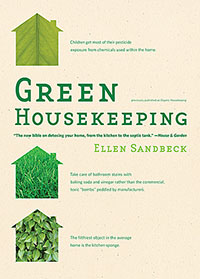
Book Review: Green Housekeeping
Green Housekeeping
by Ellen Sandbeck
Easily a great reference to all things clean, Green Housekeeping has some really great tips and ideas for cleaning everything in, under, and around your home WITHOUT any chemicals. Most of the cleaning products listed in the book are already in your kitchen pantry. Vinegar, baking soda, salt, vodka, and potentially some borax seems to be all you need to clean anything that stains, splatters, or stinks. There is also a good section on pest control in and outside of the home. Sandbeck seems to have some serious OCD issues when it comes to clutter. Her chapter on decluttering was the most obsessive I've seen on the subject, but I strangely found her OCD highly entertaining. Her bathroom cleaning routine, though advertised as only taking "5 minutes a day" seems to use "5 towels a day". You definitely need a large laundry closet to heed some of her advice.
Green Housekeeping is worth having around for the next stain you can't seem to remove, the appliances you want sparkling, or the bug you want dead, all without toxic chemicals.
by Ellen Sandbeck
Easily a great reference to all things clean, Green Housekeeping has some really great tips and ideas for cleaning everything in, under, and around your home WITHOUT any chemicals. Most of the cleaning products listed in the book are already in your kitchen pantry. Vinegar, baking soda, salt, vodka, and potentially some borax seems to be all you need to clean anything that stains, splatters, or stinks. There is also a good section on pest control in and outside of the home. Sandbeck seems to have some serious OCD issues when it comes to clutter. Her chapter on decluttering was the most obsessive I've seen on the subject, but I strangely found her OCD highly entertaining. Her bathroom cleaning routine, though advertised as only taking "5 minutes a day" seems to use "5 towels a day". You definitely need a large laundry closet to heed some of her advice.
Green Housekeeping is worth having around for the next stain you can't seem to remove, the appliances you want sparkling, or the bug you want dead, all without toxic chemicals.
Thursday, September 22, 2011
Books I Love: Taking Charge of Your Fertility
Taking Charge of Your Fertility: The definitive guide to natural birth control, pregnancy achievement, and reproductive health.
Toni Weschler, MPH
This may be one of the best books I've ever read. No I'm not kidding. I read this book two years ago when I was just starting to think about trying to conceive. In the midst of being totally amazed at what I didn't know about my own body, I couldn't help but wonder - why didn't I know this before? This is not what kids are learning in sex ed. This is not what our mother's are teaching when we first get our periods. Why? Because they didn't know. The female body has remained a mystery for even females!
This book teaches how to learn your body's natural cues of fertility. It teaches that your cycle doesn't revolve around your period, but rather ovulation. It teaches how to know when you ovulate. The natural birth control taught here is the Fertility Awareness Method (FAM). FAM is 99% effective when followed properly. It is not the "rhythm method", but rather following your bodies cues to know when you are fertile. It absolutely puts you in charge of your fertility. You can decide when to try for pregnancy or when to avoid it. It is not just looking at a calendar and counting to 14 as your OBGYN might teach. It also can tell you when you have an issue in your cycle so you and your OBGYN can be more precise and effective. The FAM combines charting your basal body temperature with other fertility cues. You may be thinking "Ugh, not charting!" A lot of people find charting laborious or stressful because they tried it when trying to conceive. I'm not going to lie, it does take work and organization. If you have trouble remembering to chart, are too busy, or don't have the discipline, then this method is not for you. But I love spreadsheets and I love learning about myself, so no big deal!
I absolutely believe that hormonal birth control is destroying our fertility. It wreaks havoc on our bodies causing more than just some uncomfortable side effects or mood swings. I believe it can cause lasting damage to your cycle. No, I don't have science to back me up. All I have is experience, testimonials, and a fair bit of speculation. So many people are experiencing miscarriages. I believe some of these could be related to hormonal birth control. Progesterone is what carries a pregnancy. Pro-gestational-hormone. It is essential to maintain pregnancy. While on birth control you do not produce progesterone. Hormonal birth control shuts down your natural progesterone and replaces it with progestin, a synthetic progesterone derived from horses' urine. Because the body is not allowed to produce it's own progesterone, it often has a bit of trouble kicking it back up once off the pill. The body could then not produce enough causing crazy cycles, delayed ovulation, or loss of a fertilized egg. Your hormones are in charge of everything from sleep, to your mood, to fertility, and a hormone imbalance can cause insomnia, headaches, weight gain, allergies, arthritis, auto-immune disorders, fatigue, etc, etc, etc. Hormone balance is very fragile, and personally, I believe hormones are nothing to mess with.
So get the book and read everything you may not know about yourself. It is totally eye opening and fascinating. Also, Weschler, has a book for teens called "Cycle Savvy: The smart teen's guide to the mysteries of her body" that teaches young girls all about their cycle. If there isn't something newer by the time my daughter enters the great abyss of puberty, then I'm definitely getting that.
Toni Weschler, MPH
This may be one of the best books I've ever read. No I'm not kidding. I read this book two years ago when I was just starting to think about trying to conceive. In the midst of being totally amazed at what I didn't know about my own body, I couldn't help but wonder - why didn't I know this before? This is not what kids are learning in sex ed. This is not what our mother's are teaching when we first get our periods. Why? Because they didn't know. The female body has remained a mystery for even females!
This book teaches how to learn your body's natural cues of fertility. It teaches that your cycle doesn't revolve around your period, but rather ovulation. It teaches how to know when you ovulate. The natural birth control taught here is the Fertility Awareness Method (FAM). FAM is 99% effective when followed properly. It is not the "rhythm method", but rather following your bodies cues to know when you are fertile. It absolutely puts you in charge of your fertility. You can decide when to try for pregnancy or when to avoid it. It is not just looking at a calendar and counting to 14 as your OBGYN might teach. It also can tell you when you have an issue in your cycle so you and your OBGYN can be more precise and effective. The FAM combines charting your basal body temperature with other fertility cues. You may be thinking "Ugh, not charting!" A lot of people find charting laborious or stressful because they tried it when trying to conceive. I'm not going to lie, it does take work and organization. If you have trouble remembering to chart, are too busy, or don't have the discipline, then this method is not for you. But I love spreadsheets and I love learning about myself, so no big deal!
I absolutely believe that hormonal birth control is destroying our fertility. It wreaks havoc on our bodies causing more than just some uncomfortable side effects or mood swings. I believe it can cause lasting damage to your cycle. No, I don't have science to back me up. All I have is experience, testimonials, and a fair bit of speculation. So many people are experiencing miscarriages. I believe some of these could be related to hormonal birth control. Progesterone is what carries a pregnancy. Pro-gestational-hormone. It is essential to maintain pregnancy. While on birth control you do not produce progesterone. Hormonal birth control shuts down your natural progesterone and replaces it with progestin, a synthetic progesterone derived from horses' urine. Because the body is not allowed to produce it's own progesterone, it often has a bit of trouble kicking it back up once off the pill. The body could then not produce enough causing crazy cycles, delayed ovulation, or loss of a fertilized egg. Your hormones are in charge of everything from sleep, to your mood, to fertility, and a hormone imbalance can cause insomnia, headaches, weight gain, allergies, arthritis, auto-immune disorders, fatigue, etc, etc, etc. Hormone balance is very fragile, and personally, I believe hormones are nothing to mess with.
So get the book and read everything you may not know about yourself. It is totally eye opening and fascinating. Also, Weschler, has a book for teens called "Cycle Savvy: The smart teen's guide to the mysteries of her body" that teaches young girls all about their cycle. If there isn't something newer by the time my daughter enters the great abyss of puberty, then I'm definitely getting that.
Thursday, September 15, 2011
What you think your baby needs.. that she doesn't!
I once heard that a new baby will cost $1,000 a month. I have no idea who came up with this number, but I would just like to say "No way!" My baby is cheap! Actually, she's priceless, but seriously light on the budget.
Maybe if you bought high-end disposable diapers, formula, and all the latest gadgets and gear, you could spend about $1,000 a month. I've already been over the cost of disposable diapers vs cloth diapers, and the cost of breastfeeding vs formula (read: free!) so you can refresh the cost savings. What I want to point out here is five unnecessary baby items that everyone thinks they gotta have!
1) Baby bathtub
I opted for a Tummy Tub and we all loved it. Mary Abilene was delighted and smiled and cooed in the TT when she was a newborn. There was hardly anything better than watching her eyes light up as we lowered her into the soothing water. But as soon as she could hold her head up, I brought her into the big bath with me because I wanted her to be comfortable in water at a young age. There I could help her lie on her back and "float" and fun was had by all. Apparently, I bathed with her one too many times and soon she refused to go back in the Tummy Tub. So from about 4 months of age on, Baby Girl has not been in a baby bathtub. We have bathed her in the sink, and she enjoyed sitting in the sink and looking at herself in the mirror as soon as she could sit up unsupported. Now, ever since about 11 months old, she has sat in the big bathtub by herself. No bathtub seat, no floaty device, no nothing except constant supervision and hands close by. I realize now that baby bathtubs and bathtub seats are pretty pointless. A newborn can be bathed in the sink and this can continue all the way until you are comfortable letting your child sit in the big tub on their own. Saves money, saves space!
2) Baby Food
While jarred baby food is unnecessary considering it takes 10 minutes to steam and puree fresh food, I'm not even talking about making your own. I'm talking no baby food. No pureeing, no mashing, no spoon feeding, no baby food. Baby Led Weaning, or Baby Led Solids is a great way to introduce solids. We started solids at six months old and Mary Abilene is a great and efficient eater. I like to think she's a better eater than other babies her age, though I don't know that statistically. Even if she doesn't eat more or more variety, it is just plain easier and more enjoyable for parent and baby to allow baby to explore food at their own pace.
3) Crib
Cosleeping is somewhat controversial, yet very traditional. Parents have slept with their babies probably from the beginning of time, and otherwise kept their babies in a basket next to them. Everyone having their own space in their own room, with their own bed is a bi-product of our, dare I say, selfish culture. Everything is bigger these days; bigger cars, bigger houses, bigger rooms. Just 50 years ago people lived a more minimalistic life. Putting a newborn in their own bed in their own room, otherwise called a "nursery" actually stems from nurseries in hospitals. Starting in the late 19th and early 20th century, babies were immediately whisked away at birth and placed in a box in the hospital nursery. Parents were led to believe that they needed the same set up at home, and thus the modern home nursery was born.
4) Crib bedding sets
While I'm on the subject, those oh-so-adorable crib bedding sets have turned out to be a bit of a waste of money. The only thing we really use from our bedroom set is the valance. But wait, that didn't even come with the set and isn't even necessary or for the baby! Bedding sets usually come with a comforter, a sheet, a dust ruffle, and a bumper for the crib. At least for my crib, you can't see the dust ruffle very well and is pretty pointless. The comforter, a baby can not use (it is advised to not use blankets in a crib with a newborn), and as far as the bumper goes, my crib has a solid portion in the back so the bumper doesn't tie where it should and thus sags. We hung the comforter on the wall as decoration, but I would have rather skipped the bedding set and picked out sheets, potentially a bumper if you think you need one, wall art or decorations, and curtains separately. That would have made a nicer and less contrived design scheme, I think.
5) Pacifiers
We all know pacifiers were invented to replace mother's nipple, but have you actually sat and thought about that? A pacifier is replacing the warm, loving, comfort of a mother's arms and bosom with a hard plastic, lifeless, plug. Don't get me wrong, I think pacifiers can be useful, but I also believe they are severely overused and misused. Pacifiers are often on registries and are bought before the baby is even born because we just assume its something baby needs. There is nothing that irks me more than giving a baby a pacifier within the first days of life. A newborn has needs and instincts that are God-given. A newborn must be allowed to suckle at the breast as often as needed. Sometimes it may feel like the baby is permanently attached to you, but this phase doesn't last long, and it is very healthy and normal. In the first few weeks of life, this "sets" the mother's milk supply. Pacifier use often leads to early weaning and a dwindling milk supply. Pacifiers can have their place if baby is very fussy in the car or another time when it is unwise to nurse, but should not replace nursing during other normal times. Sometimes a baby may need to suckle beyond what a mom can handle, and by all means, use a pacifier if it will help you keep your new-mom sanity, but I do not think it should be a regular fixture in a baby's mouth. Not using a pacifier won't save you much money, but it will certainly prevent your child from becoming attached to it and may save you from "weaning" from the pacifier later.
There are probably hundreds more unnecessary baby items and an abundance of baby products out there that seem to enable you to parent lazily. I saw a picture of a bottle holder that you strap onto the car seat and it dangles the bottle down at mouth level. No joke, I almost cried when I saw this. To not take the time out of their "busy" schedule to nurture their own child just makes me want to weep uncontrollably. But anyway, that's off topic. Point is, you don't have to take out a second mortgage to have a baby. If you adopt a more natural parenting style, babies can be quite cheap! (and totally priceless!)
Maybe if you bought high-end disposable diapers, formula, and all the latest gadgets and gear, you could spend about $1,000 a month. I've already been over the cost of disposable diapers vs cloth diapers, and the cost of breastfeeding vs formula (read: free!) so you can refresh the cost savings. What I want to point out here is five unnecessary baby items that everyone thinks they gotta have!
1) Baby bathtub
I opted for a Tummy Tub and we all loved it. Mary Abilene was delighted and smiled and cooed in the TT when she was a newborn. There was hardly anything better than watching her eyes light up as we lowered her into the soothing water. But as soon as she could hold her head up, I brought her into the big bath with me because I wanted her to be comfortable in water at a young age. There I could help her lie on her back and "float" and fun was had by all. Apparently, I bathed with her one too many times and soon she refused to go back in the Tummy Tub. So from about 4 months of age on, Baby Girl has not been in a baby bathtub. We have bathed her in the sink, and she enjoyed sitting in the sink and looking at herself in the mirror as soon as she could sit up unsupported. Now, ever since about 11 months old, she has sat in the big bathtub by herself. No bathtub seat, no floaty device, no nothing except constant supervision and hands close by. I realize now that baby bathtubs and bathtub seats are pretty pointless. A newborn can be bathed in the sink and this can continue all the way until you are comfortable letting your child sit in the big tub on their own. Saves money, saves space!
2) Baby Food
While jarred baby food is unnecessary considering it takes 10 minutes to steam and puree fresh food, I'm not even talking about making your own. I'm talking no baby food. No pureeing, no mashing, no spoon feeding, no baby food. Baby Led Weaning, or Baby Led Solids is a great way to introduce solids. We started solids at six months old and Mary Abilene is a great and efficient eater. I like to think she's a better eater than other babies her age, though I don't know that statistically. Even if she doesn't eat more or more variety, it is just plain easier and more enjoyable for parent and baby to allow baby to explore food at their own pace.
3) Crib
Cosleeping is somewhat controversial, yet very traditional. Parents have slept with their babies probably from the beginning of time, and otherwise kept their babies in a basket next to them. Everyone having their own space in their own room, with their own bed is a bi-product of our, dare I say, selfish culture. Everything is bigger these days; bigger cars, bigger houses, bigger rooms. Just 50 years ago people lived a more minimalistic life. Putting a newborn in their own bed in their own room, otherwise called a "nursery" actually stems from nurseries in hospitals. Starting in the late 19th and early 20th century, babies were immediately whisked away at birth and placed in a box in the hospital nursery. Parents were led to believe that they needed the same set up at home, and thus the modern home nursery was born.
4) Crib bedding sets
While I'm on the subject, those oh-so-adorable crib bedding sets have turned out to be a bit of a waste of money. The only thing we really use from our bedroom set is the valance. But wait, that didn't even come with the set and isn't even necessary or for the baby! Bedding sets usually come with a comforter, a sheet, a dust ruffle, and a bumper for the crib. At least for my crib, you can't see the dust ruffle very well and is pretty pointless. The comforter, a baby can not use (it is advised to not use blankets in a crib with a newborn), and as far as the bumper goes, my crib has a solid portion in the back so the bumper doesn't tie where it should and thus sags. We hung the comforter on the wall as decoration, but I would have rather skipped the bedding set and picked out sheets, potentially a bumper if you think you need one, wall art or decorations, and curtains separately. That would have made a nicer and less contrived design scheme, I think.
5) Pacifiers
We all know pacifiers were invented to replace mother's nipple, but have you actually sat and thought about that? A pacifier is replacing the warm, loving, comfort of a mother's arms and bosom with a hard plastic, lifeless, plug. Don't get me wrong, I think pacifiers can be useful, but I also believe they are severely overused and misused. Pacifiers are often on registries and are bought before the baby is even born because we just assume its something baby needs. There is nothing that irks me more than giving a baby a pacifier within the first days of life. A newborn has needs and instincts that are God-given. A newborn must be allowed to suckle at the breast as often as needed. Sometimes it may feel like the baby is permanently attached to you, but this phase doesn't last long, and it is very healthy and normal. In the first few weeks of life, this "sets" the mother's milk supply. Pacifier use often leads to early weaning and a dwindling milk supply. Pacifiers can have their place if baby is very fussy in the car or another time when it is unwise to nurse, but should not replace nursing during other normal times. Sometimes a baby may need to suckle beyond what a mom can handle, and by all means, use a pacifier if it will help you keep your new-mom sanity, but I do not think it should be a regular fixture in a baby's mouth. Not using a pacifier won't save you much money, but it will certainly prevent your child from becoming attached to it and may save you from "weaning" from the pacifier later.
There are probably hundreds more unnecessary baby items and an abundance of baby products out there that seem to enable you to parent lazily. I saw a picture of a bottle holder that you strap onto the car seat and it dangles the bottle down at mouth level. No joke, I almost cried when I saw this. To not take the time out of their "busy" schedule to nurture their own child just makes me want to weep uncontrollably. But anyway, that's off topic. Point is, you don't have to take out a second mortgage to have a baby. If you adopt a more natural parenting style, babies can be quite cheap! (and totally priceless!)
Thursday, September 8, 2011
Heck No, GMO!
You've probably heard of Genetically Modified Organisms (GMO) by now, but you may not know what they are or what the big deal is. I acquired a nice pamphlet from my favorite herbalist so I thought it would make a good blog post.
"Yes you're eating them. No, they're not safe."
- Since 1996 Americans have been eating GMO's in most processed food and some whole foods.
- A GMO is a food that has been genetically altered with foreign genes from bacteria and viruses.
- There are eight GM food crops - soy, corn, cotton, canola, and sugar beets are the biggest five. Hawaiian pineapple, zucchini, and yellow squash are the other three. About 10% of the nation's sweet corn is GMO, and that number is rising.
A GMO product is a plant that has had its DNA altered. Basically the way they alter a food's DNA is by "shooting" foreign genes into a cell or using bacteria to invade the cell with the foreign DNA. The altered cell is then cloned into a plant. You may be wondering why anyone would want to alter the DNA of a plant. The largest crop producer in the United States is Monsanto. Monsanto is an agricultural biotechnolgy corporation that produces herbicide and genetically engineered seeds (GE). They require their farmers to ONLY use their GE seeds which are genetically altered to withstand their specific herbicide, called Roundup. They produce "Roundup Ready Soy" which is GE to survive heavy doses of Roundup. The mutated genes of their soy and other plants allow Monsanto to spray Roundup killing all other plants besides their specific variety. This also causes a heavy residue of herbicide on the foods. Another reason for genetically modifying seeds is that they can create the plant, usually corn or cotton, to have its own built-in pesticide. A study in the journal "Reproductive Toxicology" found the bacteria used to modify the DNA of corn and cotton to not only show up in her blood stream, but to cross the placenta of a pregnant woman and pass it on to her unborn child. Essentially, GM foods are not only unnatural, but either have large doses of herbicide, or built-in pesticides.
The agricultural companies like Monsanto do this purely to make more money. They control the food supply and the farmers. Using their own GE seeds with their own GE herbicides allows them to produce many more crops than could be done naturally. See the documentary, Food, Inc for more details on Monsanto and the food supply.
Some may see more supply and more money as a good thing, but the problem is that GMO crops have been proven bad for us. Soy is now one of the top allergens, but soy allergies sky rocketed after the introduction of GM soy. A skin prick test shows that some people are allergic to GM soy and not natural soy. Cooked GM soy contains as much as 7 times the amount of allergens of a known natural soy. The toxin used in the DNA of corn and cotton has also been linked to allergies. The American Academy of Environmental Medicine states "Several animal studies indicate serious health risks associated with GM food", including infertility, immune problems, accelerated aging, faulty insulin regulation, and changes in major organs and the gastrointestinal system. They ask physicians to advise patients to avoid GM food.
The Food and Drug Administration (FDA) essentially is turning a blind eye to GMO foods. In 1992, they claimed they had no information showing that GM foods were substantially different from conventionally grown foods, and were therefore safe to eat. Because they deemed the food "safe to eat" no safety studies were required. Yet internal memos in the FDA made public by a lawsuit reveals their position was staged. The pamphlet states "The FDA official in charge of creating this policy was Michael Taylor, the former attorney for Monsanto, and later their vice president." In actuality, FDA scientists had repeatedly warned that GM foods can create unpredictable, hard to detect side effects including allergies, toxins, new diseases, and nutritional problems. The same GMO companies that have been found guilty of hiding toxic effects of their chemical products are in charge of determining whether GMO foods are safe.
Just last year, the Obama administration passed a bill that would allow biotech companies to genetically modify alfalfa. This is a huge blow for organic farming. Organic farmers feed their cows alfalfa, as is their natural diet, as opposed to GMO corn. Essentially if alfalfa is now GMO, cows are no longer eating their natural diet and there will be no such thing as organic dairy products or beef because the very source of the food is GMO.
What you can do: Refuse to buy GMO food. The best way to do that is to buy certified organic products, considering it is not required in the U.S., unlike other countries, to label GMO foods. I'll never forget my high school economics class that taught me that whatever you buy is your stamp of approval for that item. If you buy GMO corn you are announcing that you want GMO corn and you want them to continue to produce GMO corn. Refuse to buy and the demand goes down. If more people understand GMO and refuse to buy those products then we are telling biotech corporations that we do not want GMO; we want natural food!
Further reading: www.ResponsibleTechnology.org
and download a Non-GMO shopping guide at www.nongmoshoppingguide.com
"Yes you're eating them. No, they're not safe."
- Since 1996 Americans have been eating GMO's in most processed food and some whole foods.
- A GMO is a food that has been genetically altered with foreign genes from bacteria and viruses.
- There are eight GM food crops - soy, corn, cotton, canola, and sugar beets are the biggest five. Hawaiian pineapple, zucchini, and yellow squash are the other three. About 10% of the nation's sweet corn is GMO, and that number is rising.
A GMO product is a plant that has had its DNA altered. Basically the way they alter a food's DNA is by "shooting" foreign genes into a cell or using bacteria to invade the cell with the foreign DNA. The altered cell is then cloned into a plant. You may be wondering why anyone would want to alter the DNA of a plant. The largest crop producer in the United States is Monsanto. Monsanto is an agricultural biotechnolgy corporation that produces herbicide and genetically engineered seeds (GE). They require their farmers to ONLY use their GE seeds which are genetically altered to withstand their specific herbicide, called Roundup. They produce "Roundup Ready Soy" which is GE to survive heavy doses of Roundup. The mutated genes of their soy and other plants allow Monsanto to spray Roundup killing all other plants besides their specific variety. This also causes a heavy residue of herbicide on the foods. Another reason for genetically modifying seeds is that they can create the plant, usually corn or cotton, to have its own built-in pesticide. A study in the journal "Reproductive Toxicology" found the bacteria used to modify the DNA of corn and cotton to not only show up in her blood stream, but to cross the placenta of a pregnant woman and pass it on to her unborn child. Essentially, GM foods are not only unnatural, but either have large doses of herbicide, or built-in pesticides.
The agricultural companies like Monsanto do this purely to make more money. They control the food supply and the farmers. Using their own GE seeds with their own GE herbicides allows them to produce many more crops than could be done naturally. See the documentary, Food, Inc for more details on Monsanto and the food supply.
Some may see more supply and more money as a good thing, but the problem is that GMO crops have been proven bad for us. Soy is now one of the top allergens, but soy allergies sky rocketed after the introduction of GM soy. A skin prick test shows that some people are allergic to GM soy and not natural soy. Cooked GM soy contains as much as 7 times the amount of allergens of a known natural soy. The toxin used in the DNA of corn and cotton has also been linked to allergies. The American Academy of Environmental Medicine states "Several animal studies indicate serious health risks associated with GM food", including infertility, immune problems, accelerated aging, faulty insulin regulation, and changes in major organs and the gastrointestinal system. They ask physicians to advise patients to avoid GM food.
The Food and Drug Administration (FDA) essentially is turning a blind eye to GMO foods. In 1992, they claimed they had no information showing that GM foods were substantially different from conventionally grown foods, and were therefore safe to eat. Because they deemed the food "safe to eat" no safety studies were required. Yet internal memos in the FDA made public by a lawsuit reveals their position was staged. The pamphlet states "The FDA official in charge of creating this policy was Michael Taylor, the former attorney for Monsanto, and later their vice president." In actuality, FDA scientists had repeatedly warned that GM foods can create unpredictable, hard to detect side effects including allergies, toxins, new diseases, and nutritional problems. The same GMO companies that have been found guilty of hiding toxic effects of their chemical products are in charge of determining whether GMO foods are safe.
Just last year, the Obama administration passed a bill that would allow biotech companies to genetically modify alfalfa. This is a huge blow for organic farming. Organic farmers feed their cows alfalfa, as is their natural diet, as opposed to GMO corn. Essentially if alfalfa is now GMO, cows are no longer eating their natural diet and there will be no such thing as organic dairy products or beef because the very source of the food is GMO.
What you can do: Refuse to buy GMO food. The best way to do that is to buy certified organic products, considering it is not required in the U.S., unlike other countries, to label GMO foods. I'll never forget my high school economics class that taught me that whatever you buy is your stamp of approval for that item. If you buy GMO corn you are announcing that you want GMO corn and you want them to continue to produce GMO corn. Refuse to buy and the demand goes down. If more people understand GMO and refuse to buy those products then we are telling biotech corporations that we do not want GMO; we want natural food!
Further reading: www.ResponsibleTechnology.org
and download a Non-GMO shopping guide at www.nongmoshoppingguide.com
Tuesday, September 6, 2011
Potty Update - 3 weeks in!
In my last post, less than a week ago, I talked about how we are helping our baby learn to use the potty. Check out that post for potty training babies and young toddlers. This is an update on our super fast, amazingly, awesome progress.
Toward the end of last week, Thursday and Friday-ish, she wasn't going in the potty near as much as she was Monday and Tuesday-ish. Maybe once a day; I think she didn't go at all in it on Friday. Maybe it is a two steps forward one step back kind of thing. Well, as of Sunday, she started doing a sign for potty! We were teaching her to pat her tummy with both hands when she potties. On Sunday she suddenly started patting her chest at random times. We were thinking "Now what is that?" She has a bit of sign confusion, signing "all done" when she actually means she wants something. But it didn't take more than 2 pats before I realized that she was doing her version of the potty sign. She pats her chest while she sits on the potty, and pats her chest while she goes potty! By Monday we were thinking "This is fantastic, but she needs to learn to pat her chest or tummy before she needs to go." We were going to start patting our tummy and her tummy before we take her to the potty. But today, just one day later, she is starting to pat her chest right before she has to go!
This morning, she was sitting on the floor and looked up at me and patted her chest. I said "You have to go pee-pee?" Thinking she was currently going pee-pee, I swooped her up and promptly stuck her on the potty. As soon as her little fanny hit the seat she starts to tinkle! Yay! She did it! She told me she had to go then she went! No more than an hour later, my husband was sitting at his computer and she toddles up, taps him on the knee and pats her chest! He scooped her up, managed to get her tights and diaper off, sits her on the potty, and she tinkles! I'm so excited I can barely stand myself! She continued to do this throughout the day. I didn't even have to stare at her to wonder when she needed to go. I was even making dinner and she was playing in the kitchen, she grunted at me, I looked at her and she patted her chest. I took her to the potty and she tinkled! She tinkled in the potty ever single time she had to go today that she was at home. She only wore two diapers - one during her nap, and the other while we were out this afternoon. My next question is; How am I going to find panties to fit someone this tiny?
She will be 13 months old on Thursday. Just shy of 13 months old, she has learned to potty in a little potty, has learned a simple sign for potty, and has started doing her sign to communicate with us that she has to go potty. We started sitting her on the potty on August 13. Now, less than a month later, she tells us when she needs to go and goes in the potty regularly. This is seriously revolutionary! My mother-in-law asked why we would want to start potty training her so young - the answer is simply: because we can! I know my baby is a super-genius and all, but I truly believe that every baby could learn. Maybe at different paces, maybe at different ages, but the fact of the matter is that you do not have to wait until age 2 or 3 to start potty learning. Don't delay, start today!
Toward the end of last week, Thursday and Friday-ish, she wasn't going in the potty near as much as she was Monday and Tuesday-ish. Maybe once a day; I think she didn't go at all in it on Friday. Maybe it is a two steps forward one step back kind of thing. Well, as of Sunday, she started doing a sign for potty! We were teaching her to pat her tummy with both hands when she potties. On Sunday she suddenly started patting her chest at random times. We were thinking "Now what is that?" She has a bit of sign confusion, signing "all done" when she actually means she wants something. But it didn't take more than 2 pats before I realized that she was doing her version of the potty sign. She pats her chest while she sits on the potty, and pats her chest while she goes potty! By Monday we were thinking "This is fantastic, but she needs to learn to pat her chest or tummy before she needs to go." We were going to start patting our tummy and her tummy before we take her to the potty. But today, just one day later, she is starting to pat her chest right before she has to go!
This morning, she was sitting on the floor and looked up at me and patted her chest. I said "You have to go pee-pee?" Thinking she was currently going pee-pee, I swooped her up and promptly stuck her on the potty. As soon as her little fanny hit the seat she starts to tinkle! Yay! She did it! She told me she had to go then she went! No more than an hour later, my husband was sitting at his computer and she toddles up, taps him on the knee and pats her chest! He scooped her up, managed to get her tights and diaper off, sits her on the potty, and she tinkles! I'm so excited I can barely stand myself! She continued to do this throughout the day. I didn't even have to stare at her to wonder when she needed to go. I was even making dinner and she was playing in the kitchen, she grunted at me, I looked at her and she patted her chest. I took her to the potty and she tinkled! She tinkled in the potty ever single time she had to go today that she was at home. She only wore two diapers - one during her nap, and the other while we were out this afternoon. My next question is; How am I going to find panties to fit someone this tiny?
She will be 13 months old on Thursday. Just shy of 13 months old, she has learned to potty in a little potty, has learned a simple sign for potty, and has started doing her sign to communicate with us that she has to go potty. We started sitting her on the potty on August 13. Now, less than a month later, she tells us when she needs to go and goes in the potty regularly. This is seriously revolutionary! My mother-in-law asked why we would want to start potty training her so young - the answer is simply: because we can! I know my baby is a super-genius and all, but I truly believe that every baby could learn. Maybe at different paces, maybe at different ages, but the fact of the matter is that you do not have to wait until age 2 or 3 to start potty learning. Don't delay, start today!
Subscribe to:
Posts (Atom)